

Blackhawk Golden ‘K’ General Meeting
Minutes
September 9th, 2026
Tom Neumann presided, and called the Oak Hill Cemetery Chapel meeting to order at 9:30AM.
Tom Neumann led with the singing of America, the National Anthem, and the Pledge of Allegiance.
Invocation: Bob Knudson, mentioning blessing the food and drink, and the children.
Jokes: Joker Roger Willeford had a good joke, “What did one ocean say to the other? Nothing, they just waved” and two more.
Member Health: Tom Neumann had a status update on Secretary Paul Neitzel’s wife, who is in poor health after a car accident.
Other Announcements: Ryan Lewis spoke upon a new order is being prepared for embroidered shirts.
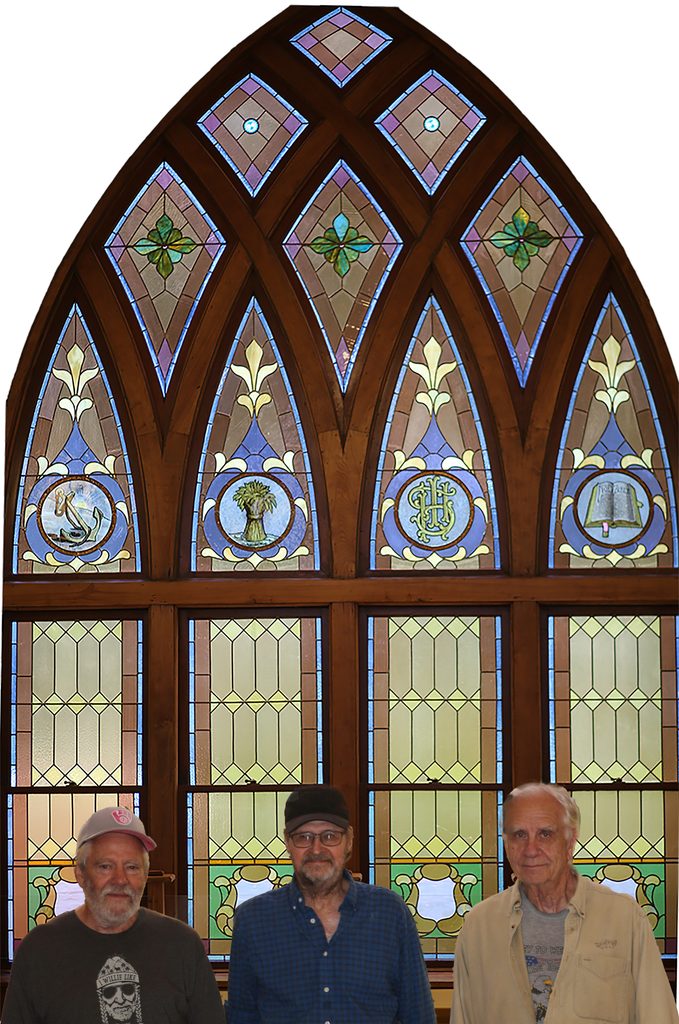
Tom Neumann introduced the day’s speakers, Richard Snyder and Paul Williams. Richard was the speaker back in July. Paul began, and provided some information about the Oak Hill Cemetery Chapel and grounds. The property has 24,000 graves, and room for 124,000. Tree roots are the largest problem for headstones. Individual families are responsible for their gravestones. Many other facts were shared and questions, answered.
There are organic cleaners for headstones. Bleach and other chemicals eventually cause damage.
If stones are broken, a special two-part epoxy is used for repair.
FindaGrave is a website for locating graves worldwide.
Some have stories behind them. There are many stillborns.
Many graves are abandoned.
A quote is inscribed on a wall plaque, “Show me your cemetery and I’ll tell you what kind of people you have” – Benjamin Franklin.
All work is volunteer.
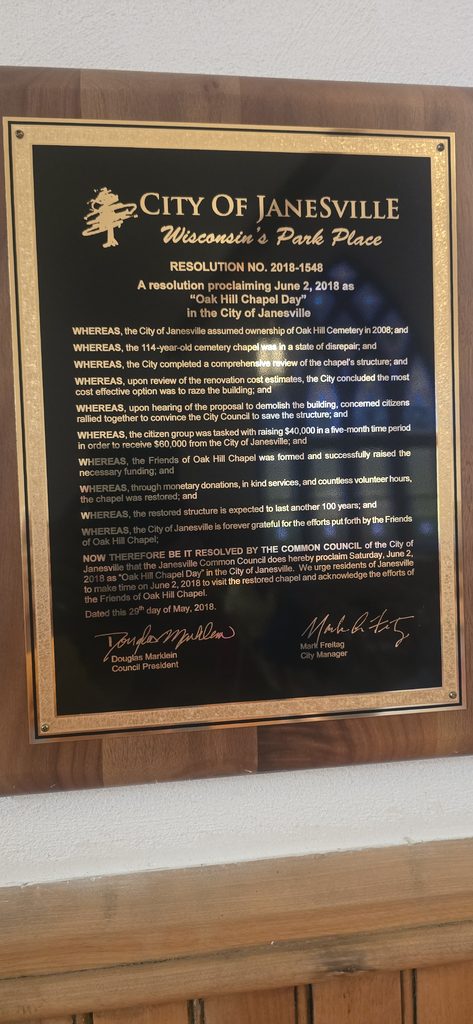
Richard began with Paul and Jim Crittendon to save the chapel back in 2013, all the way up to the grand opening in 2018.
The paneling is red birch.
The doors were built by the Amish.
Kiwanis member Roger Williford asked, “When was it originally constructed?” Richard Snyder replied, “1899.”
Kiwanian Carl Cramer inquired, “Who built it?” Richard answered, “The Knights of Pythias. They stood for friendship, charity, and benevolence.”
Kiwanis member Ray Szczepaniak asked, “What about the glass orbs?” Richard, “The blue orbs are gems. Everything else is original, aside from the 13-inch anchor section.”
Kiwanian Tom Neumann inquired, “Who is Starr Judd?” Richard responded, “He was the son of Dr. Judd, who took ill and died at a young age while accompanying his father visiting a patient.”
Ray Szczepaniak asked, “Do you give presentations for high schoolers?” Richard replied, “Some assisted in the reconstruction. It is a good idea.”
Kiwanis member Jenny Turco inquired, “What is the history of the back window?” Richard answered, “It was outside, in the red brick.”
A tour of the facility followed. Members appreciated the time the members took and their presentation.
Tom Neumann thanked Richard, Paul and Jim for speaking.
Tom Neumann adjourned the meeting with a ring of the bell at 10:00AM.
Reminders: There is Programs Committee meeting next week.
On this day:
1753 First steam engine arrives in North American colonies
1767 Colegio de San Ignacio de Loyola Vizcaínas, the oldest continuously operating educational institution in Mexico, opens for the education of girls and women in Mexico City
1776 Congress officially renames the country as the United States of America (from the United Colonies)
1817 Alexander Twilight, likely the first African American to graduate from a US college, receives a BA degree from Middlebury College
1830 Charles Durant, the first US aeronaut, flies a balloon from Castle Garden, NYC, to Perth Amboy, NJ, covering a distance of about 25 miles in 3 hours
1836 Ralph Waldo Emerson publishes his influential essay “Nature” in the US, outlining his beliefs in transcendentalism
1839 English scientist and astronomer John Herschel takes the first glass plate photograph
1850 California is admitted as the thirty-first state of the Union
1850 Territories of New Mexico and Utah created
1861 Nurse Sally Tompkins is officially commissioned as an officer (and its only female officer) by the Confederate States Army
1886 The Berne Convention for the Protection of Literary and Artistic Works is finalized
1892 Edward Emerson Barnard at Lick Observatory discovers Amalthea, Jupiter’s fifth moon
1895 American Bowling Congress forms in New York City
1901 Cornerstone is laid on the New York Stock Exchange building
1908 Orville Wright makes the first hour-long airplane flight, lasting 62 minutes and 15 seconds at Fort Myer, Virginia
1914 Boston Brave George Davis no-hits Philadelphia Phillies 7-0
1919 The hydrofoil designed by Alexander Graham Bell, his wife Mabel Bell, and F.W. Casey Baldwin sets a new water speed record of 114 km/h on Bras d’Or, Nova Scotia
1926 National Broadcasting Company (NBC) founded by the Radio Corporation of America (RCA)
1927 Tony Lazzeri Day at Yankee Stadium
1945 First “bug” in a computer program is discovered by a team of engineers, including Grace Hopper, in Cambridge, Massachusetts, when a real-life moth is removed with tweezers from a relay and taped into the logbook
1950 First use of TV laugh track by “The Hank McCune Show” in the US
1956 Elvis Presley’s first appearance on “The Ed Sullivan Show”
1965 Tibet becomes an autonomous region of China
1966 The National Traffic and Motor Vehicle Safety Act is signed into law by U.S. President Lyndon B. Johnson, establishing the first federal safety standards for vehicles and roads
1966 American comedian and actor Adam Sandler, who was known for his portrayal of infantile but endearing characters, was born
1967 First successful test flight of a Saturn V
1971 Apple Records releases John Lennon’s second solo studio album, “Imagine,” in the US; it tops the charts in the US, UK, Australia, and three other countries
1972 Connection found between Mammoth Cave Ridge and Flint cave systems in Kentucky, joining 144 miles of passages, making it the world’s longest known cave system (later mapped at 420 miles)
1975 Viking 2 Mars probe launches
1979 31st Emmy Awards: “Taxi,” “Lou Grant,” Ron Leibman, and Ruth Gordon win
1982 Conestoga 1, the first private commercial rocket, makes a suborbital flight
1982 The space shuttle Columbia is mated with solid rocket boosters and an external tank in preparation for its fifth flight, STS-5
1983 Radio Shack announces its Color Computer 2 (CoCo2)
1986 Minnesota’s Tommy Kramer passes for six touchdowns against Green Bay, 42-7
1987 Larry Bird of the Celtics begins an NBA free throw streak of 59 consecutive successful shots
1988 “Look Away” single released by Chicago (Billboard Song of the Year 1989)
1994 Space Shuttle STS 64 (Discovery 20) launches into orbit
Rumor has it that the first man to take out his priest for a beer was St. Hopswald of Aleyard. This may be apocryphal, but International Buy a Priest a Beer Day certainly is not. It is a day when Catholics build relationships with their priests by taking them out for a beer. In a larger sense, it is a day when Catholics show appreciation for their priests and share with them how their ministry has been important to them. Beer isn’t even required. The priest could be bought a root beer, or they could be invited over for dinner. If there isn’t much time, they could simply be let known that they are being prayed for, and a prayer could be said for them. One also doesn’t need to have a priest or be Catholic to celebrate. A person of any religious belief can buy a priest a beer, or someone of a different faith could buy their spiritual leader a beer.
—
National Teddy Bear Day is dedicated to the stuffed bear that was named after the 26th President of the United States, Theodore Roosevelt. In November 1902, Roosevelt, an avid hunter, went on a hunting excursion organized by Mississippi’s governor, Andrew Longino, in Smedes, Mississippi. Roosevelt was accompanied by some aides, other hunters, and reporters, as well as a hunting guide, Holt Collier, and his hunting dogs. After a few days without success, Roosevelt and the hunting dogs were on the trail of a black bear. Having thought that they had lost the bear, Roosevelt went back to camp, but Collier and his dogs kept searching. Collier and his dogs found the 235 pound bear, and the dogs circled it and began biting and attacking it. The bear killed one of the dogs, and Collier clubbed the bear over the head and tied it to a tree. He bugled for Roosevelt, who found the bear mauled from the dogs, and refused to shoot it. He also forbade anyone else from shooting it, but as the bear was so injured, he had the bear put out of its misery by having it be killed with a hunting knife.
A few days later, a cartoon titled “Drawing the line in Mississippi”, which showed Roosevelt refusing to shoot the bear, was drawn by Clifford Berryman, and appeared in the Washington Post. Rose and Morris Mitchom, store owners in New York City, saw the cartoon and were inspired to create the teddy bear, which they originally called “Teddy’s bear”. They eventually founded the Ideal Toy Company which produced the bears, and even allegedly wrote to Roosevelt asking his permission to use his name for their bear. About the same time as the Mitchom’s debuted their bear, Richard Steiff of Germany created a stuffed teddy bear as well, which also became very popular.
Since the creation of the teddy bear, it has become one of the most iconic toys and comfort items for children, and has also been featured in songs, television shows, and movies. Teddy bears have also become important collector’s items for adults. But, maybe adults don’t just collect bears because of their monetary value. A recent study found that over half of adults still have their favorite stuffed animal they grew up with, 40% sleep with it by their side, and 70% said they want to keep it for the rest of their lives!
—
Tester’s Day commemorates the day in 1947 when the first actual bug was found in a computer—and by actual bug, we mean real and once-was-living bug. Scientists at Harvard University had been working on the Mark II Aiken Relay Calculator when they found a moth stuck between the two solenoid contacts of the electromechanical relay. The moth had shorted out the relay. Some say Grace Hopper found the bug, while others say it was William “Bill” Burke or another scientist. One of the scientists working on the computer, originally thought to have been Hopper, taped the moth into the computer’s logbook and labeled it with the note, “First actual case of bug being found.” Being that it specified “actual,” it seems to imply other types of computer bugs had already been the norm. Nonetheless, it was Hopper and the other scientists she worked with who helped popularize the terms “bug” and “debug,” which became standard language for computer programmers soon afterward.
“Bug” had long been an engineering term. Way back in 1878, Thomas Edison had written a letter using the term, in which he said:
It has been just so in all of my inventions. The first step is an intuition, and comes with a burst, then difficulties arise—this thing gives out and [it is] then that “Bugs”—as such little faults and difficulties are called—show themselves and months of intense watching, study and labor are requisite before commercial success or failure is certainly reached.
The word appeared in other locations following this, including in Webster’s Second International Dictionary in 1934. In current times, a computer bug can be defined as a problem with a computer program or system which causes an incorrect or unexpected result. Bugs usually come from errors in the source code or the program’s design, or in components or operating systems that are used by the programs. Some bugs are caused by compilers. The effects of bugs may be minuscule, or they may make a computer crash or freeze. There are also security bugs that may allow a malicious user to gain access. “Debug” dates to at least 1945 when it referred to issues with aircraft engines. Debugging now describes the process of identifying and eliminating computer bugs. It seems apparent that the name of today’s holiday is Tester’s Day because software testers are those who look for bugs. The day is dedicated to Grace Hopper and all other software testers.
Minutes by Ryan Lewis.
Credit: Dave Figi, and Ryan Lewis, photographs.
Note: Kiwanis and its members are not responsible for errors or omissions. We are open to discussion if you would like to request an alteration. This content may only be reproduced without alteration and with credit to the original author(s).




Leave a Reply
You must be logged in to post a comment.