Blackhawk Golden ‘K’ General Meeting
Minutes
October 21st, 2026
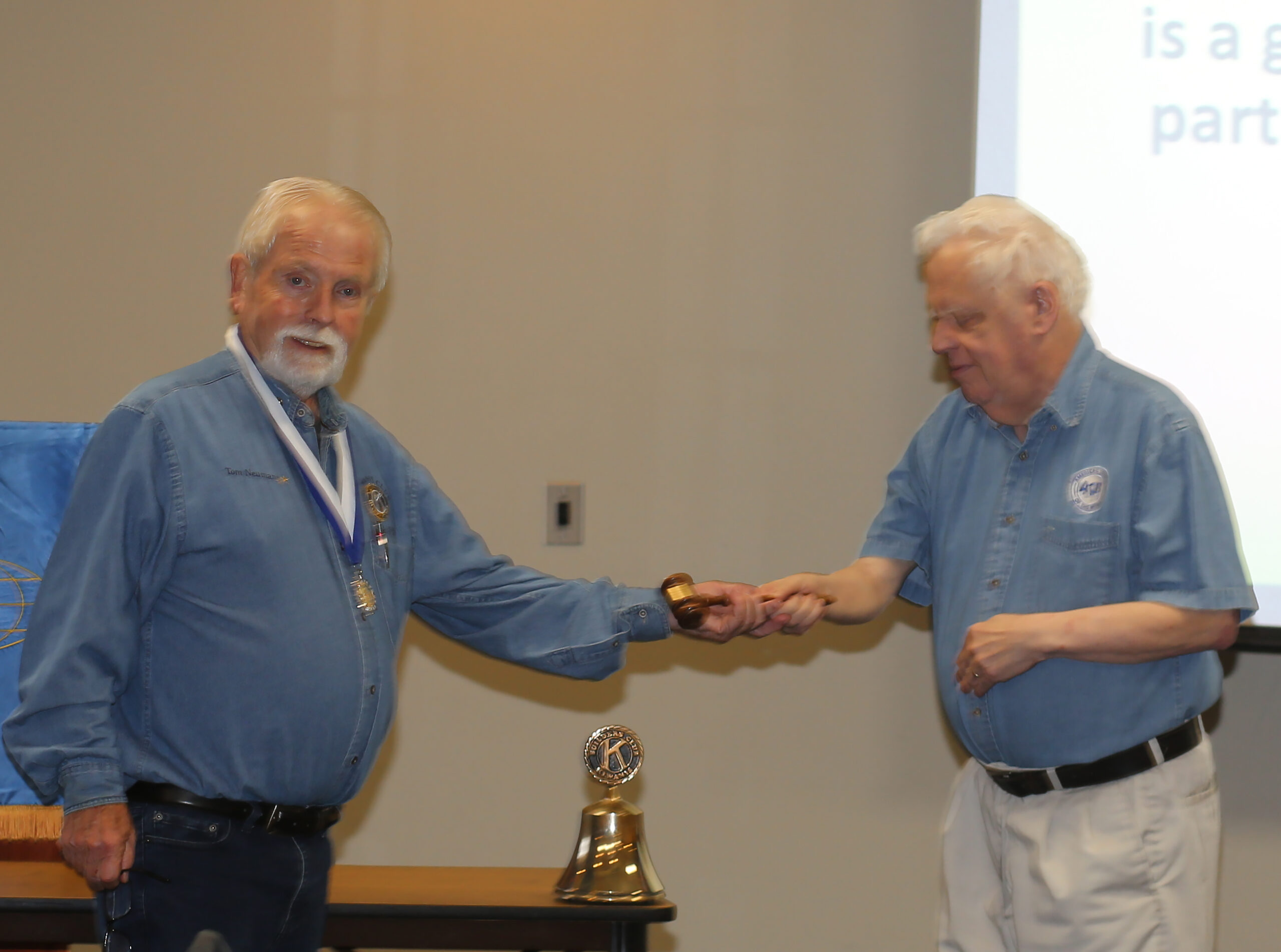
President Tom Neumann presided, and called the meeting to order with a ring of the bell at 9:30AM.
Richard Johnson led with the singing of America, the National Anthem, and the Pledge of Allegiance.
Invocation: Bob Knudson, mentioning good weather, and the children.
Raffle: Ray Szczepaniak oversaw the ticket sales and drawing this week.
The weekly pot was $11 and the big (Joker) pot was $355.
Someone drew a ticket from the bucket, ticket number 5588. Congratulations to the winner, John Janes.
The deck of cards has 25/53 cards remaining. John Janes drew the A♥.
Tom Neumann thanks greeters Ray Cummings and (a substitute), invocator Bob Knudson, rafflemaster Ray Szczepaniak, and server Bob Knudson.
Happy Box: John Janes announced he is happy because he won the raffle. He asked Mel Lemirande where to donate the funds, which went to the Truck on Ice!
Member Health: Maury Frey had a status update on Glenn Disrude, who is receiving a pacemaker upgrade next week and will be away for a few.
Other Announcements: Ryan Lewis spoke upon the flag box, returned and being installed tomorrow. A ‘Thank You’ card is being passed around.
Committee Reports: John Janes announced several Blood Drives are approaching. The need is great!
John Janes announced the Truck on Ice is on the way!
Greg Turco announced Jenny Turco created a logo for the Kiwanis Foundation!
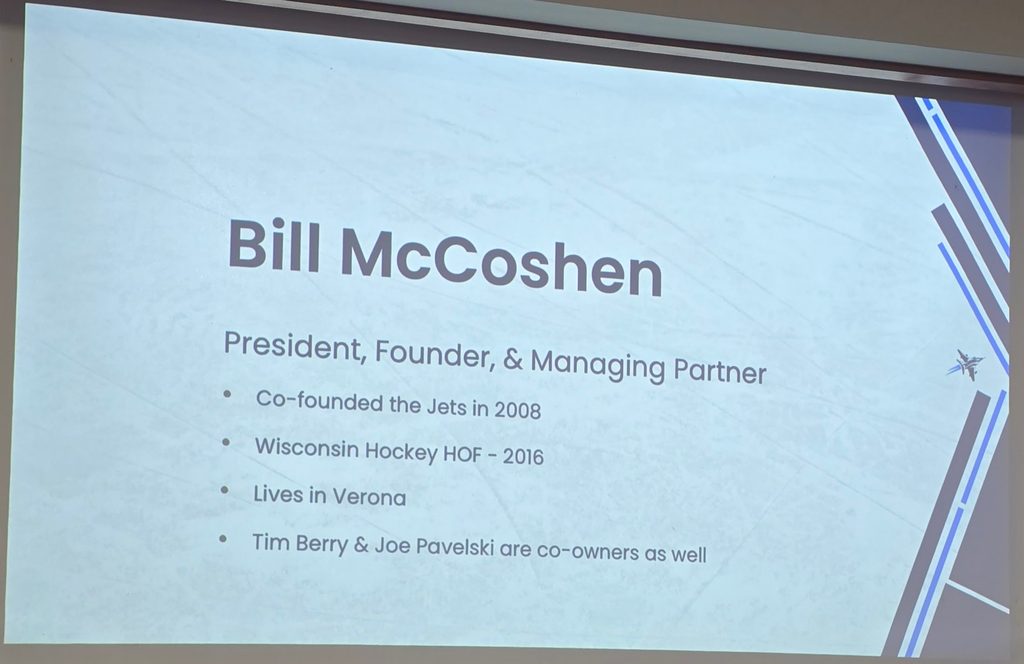
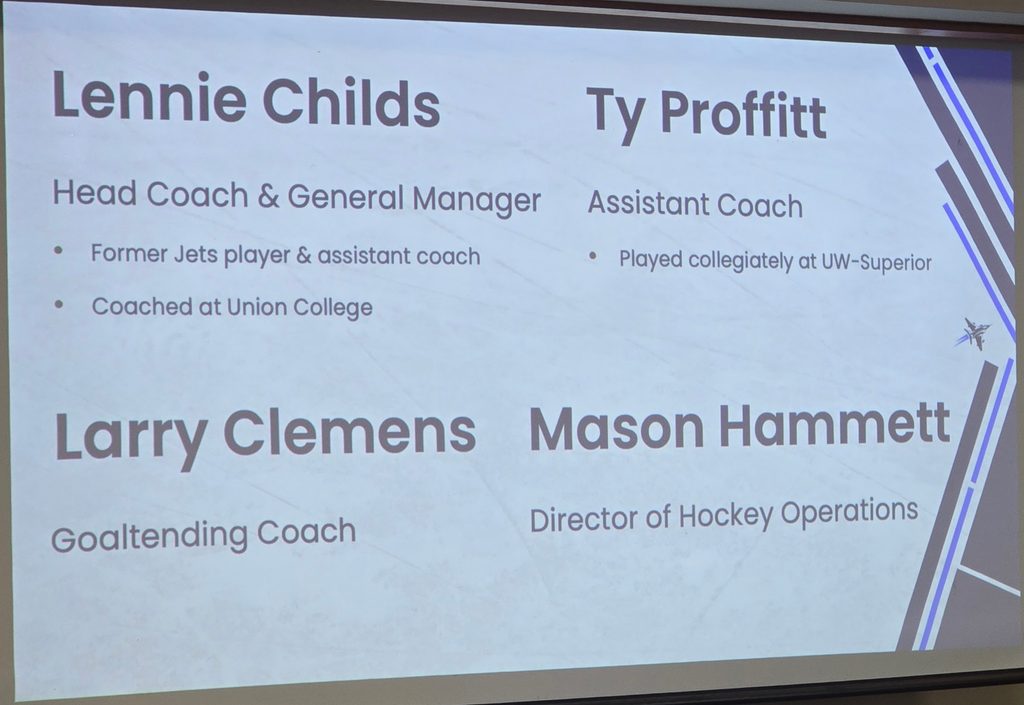
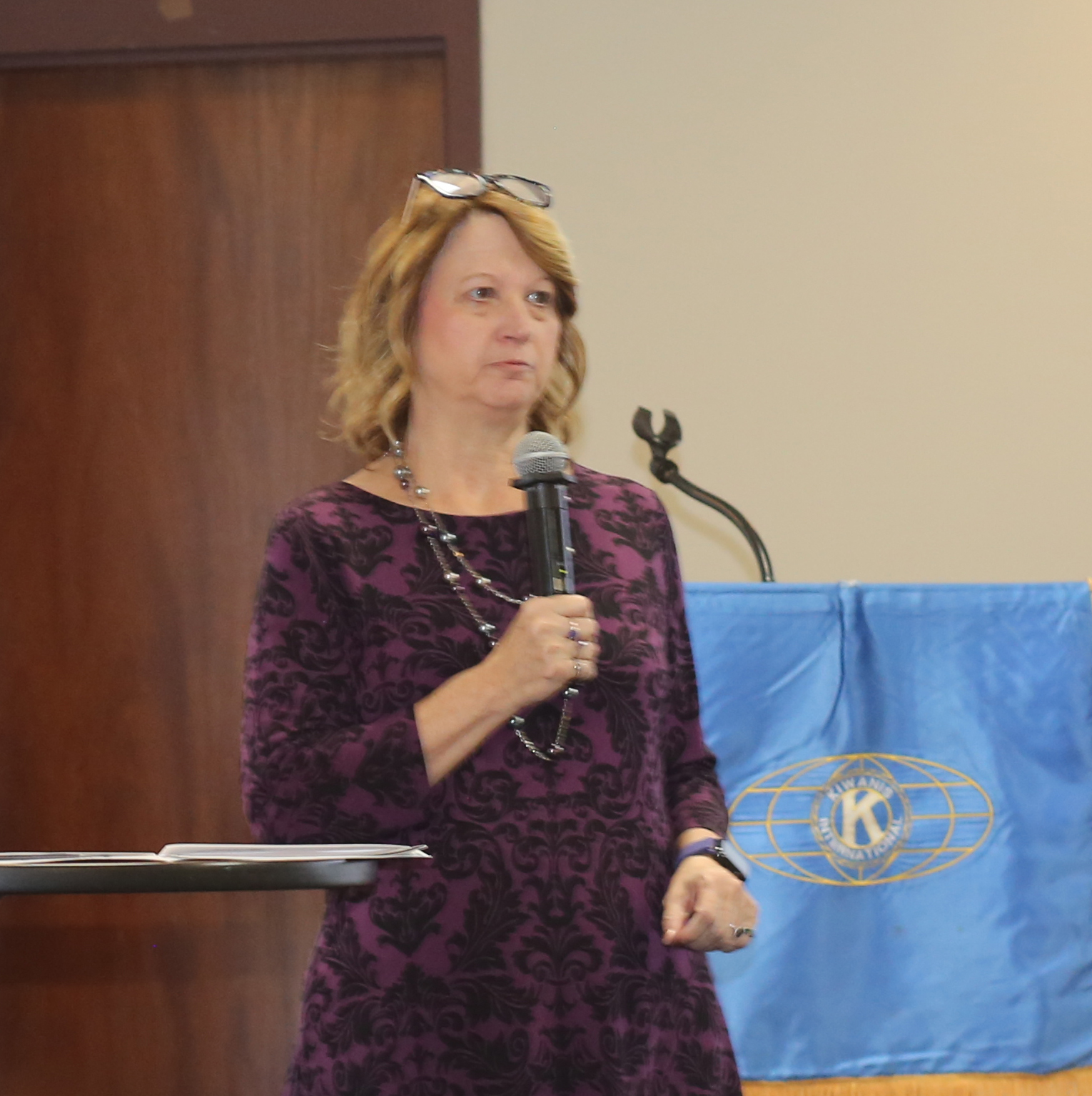
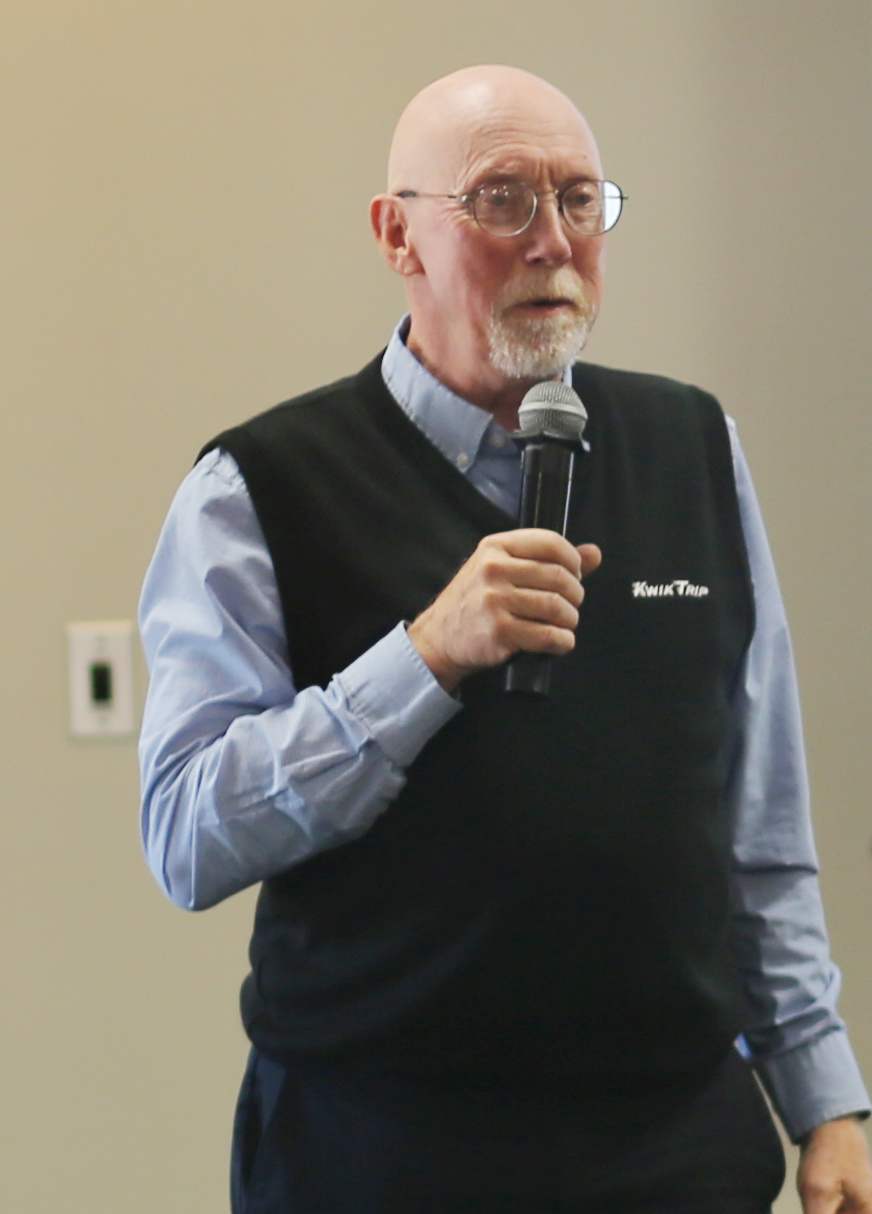
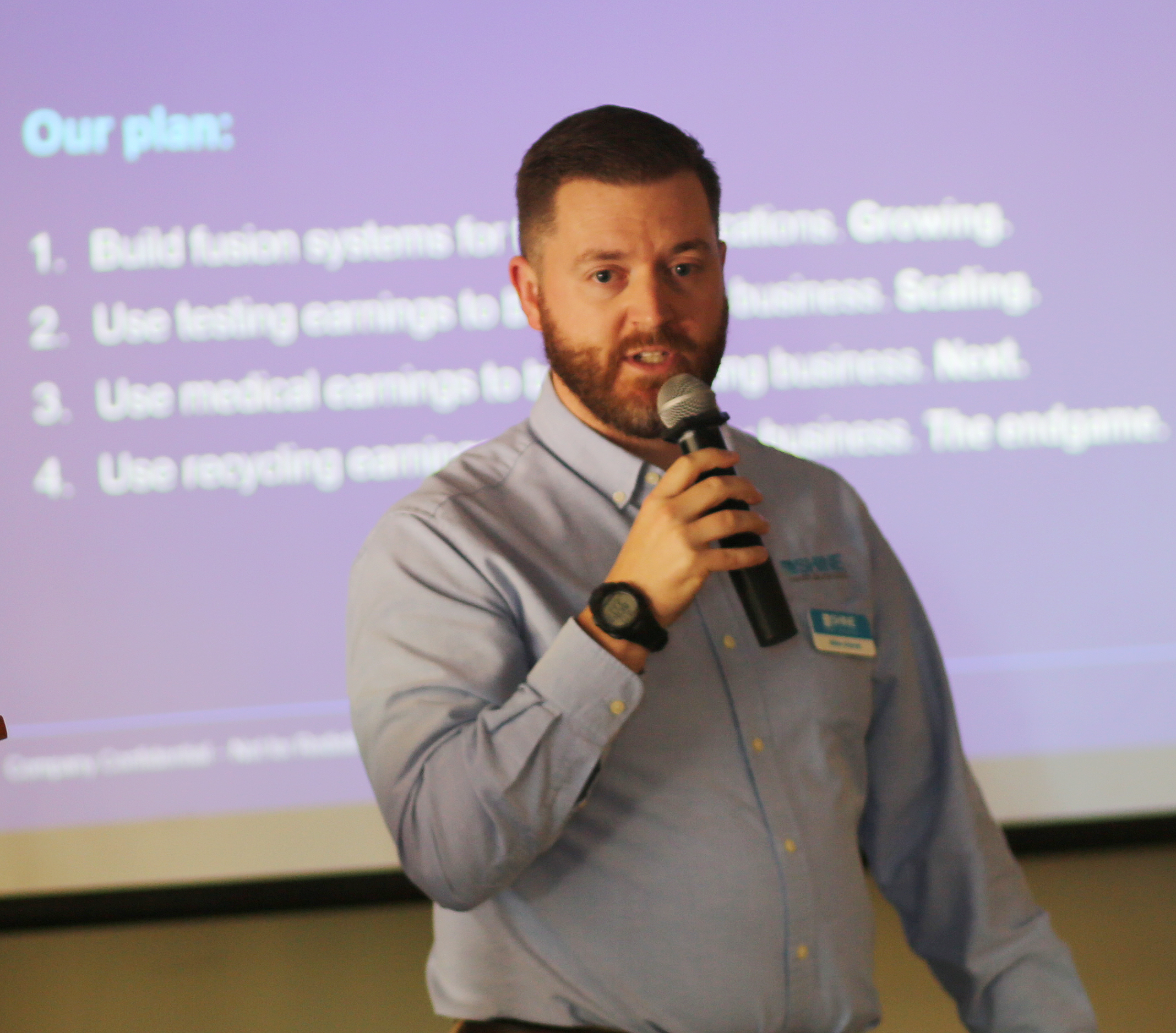
Ryan Lewis introduced the day’s speaker, Andy Zywicki. Andy Zywicki has been with the Janesville Jets as the Director of Corporate Sponsorships / Suites and Group Sales since August of 2025. He brings a wealth of knowledge from a 28-year career in college athletics and sports marketing.
Andy is from South Milwaukee, Wisconsin, originally, but now lives in Oregon with his wife Maggie, daughter Abby, and Labrador Retrievers Javy and Augie. He earned his undergraduate degree from the University of Wisconsin-Madison and his graduate degree from the University of Southern Mississippi. Combined with extensive experience in sponsorship sales and premium hospitality cultivated with the athletic departments at Wisconsin, Southern Miss, and Illinois, and via the American Family Insurance Championship, Andy brings the expertise, creativity, and selfless mindset needed to create an exceptional partner experience.
Whether your business is looking to become part of the Jamesville Jets sponsor family or you’re planning a staff holiday party, client event, or group gathering in the Center Suite, Andy is committed to making the experience seamless, memorable, and valuable for your organization.
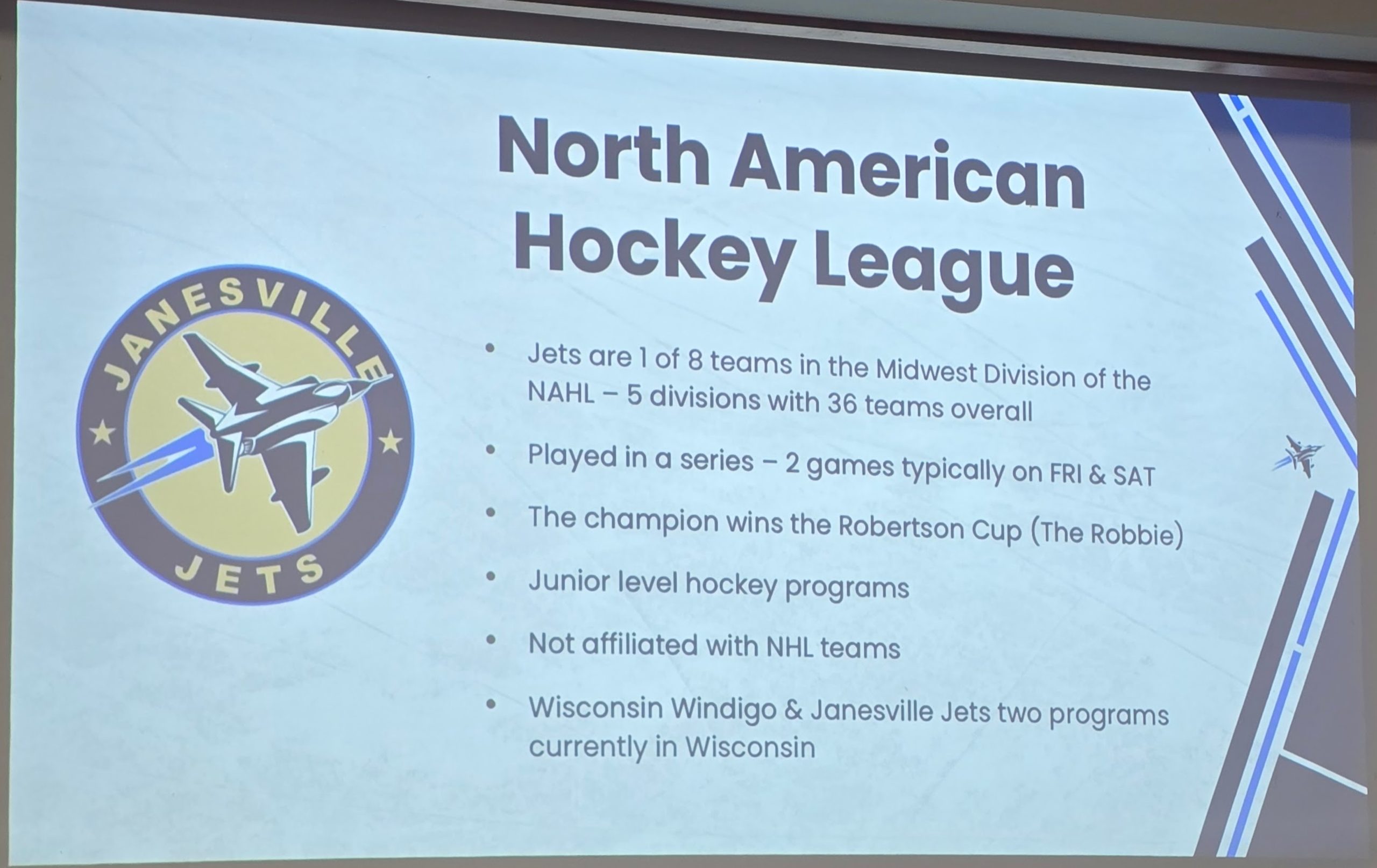
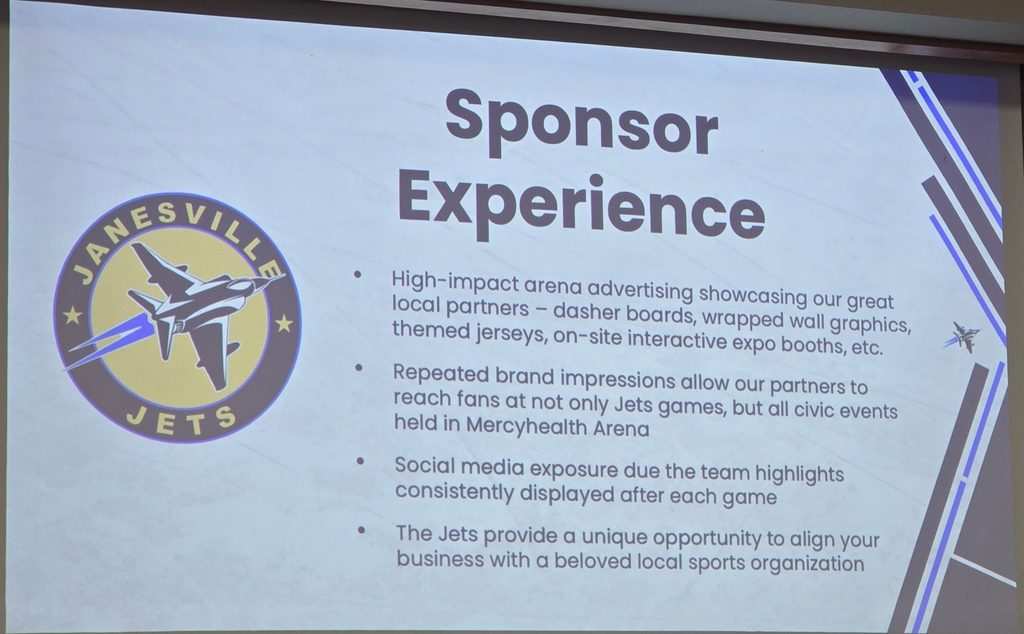
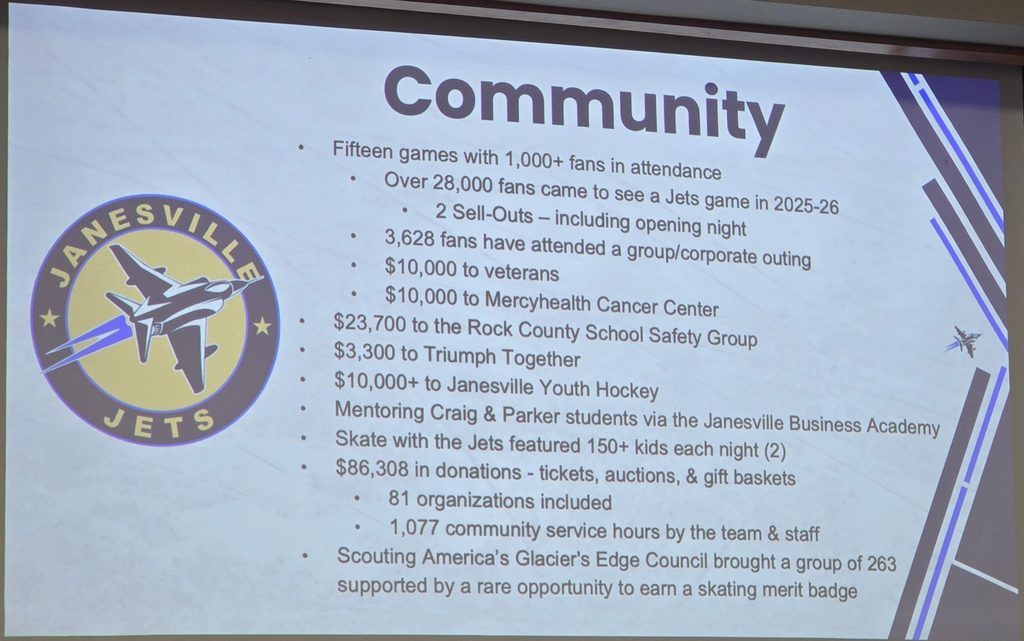
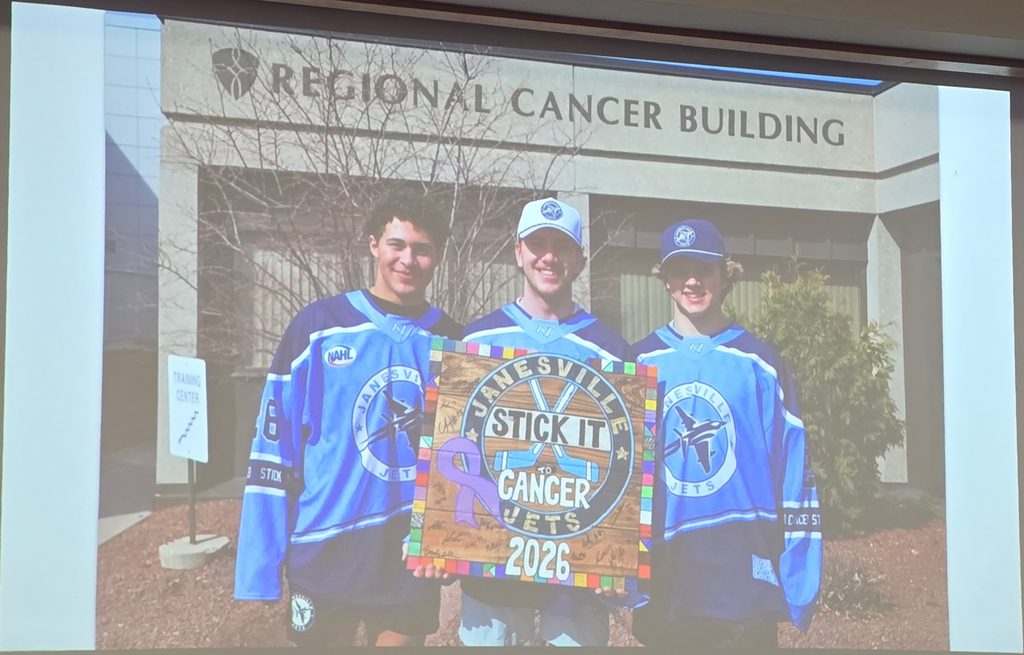
Andy proceeded to present about the Janesville Jets.
The Janesville Jets has regular theme nights: Ag night with tractor pulls on ice, and Trades Night with CAT and many other companies lining up heavy equipment in the parking lot as some of the many examples.
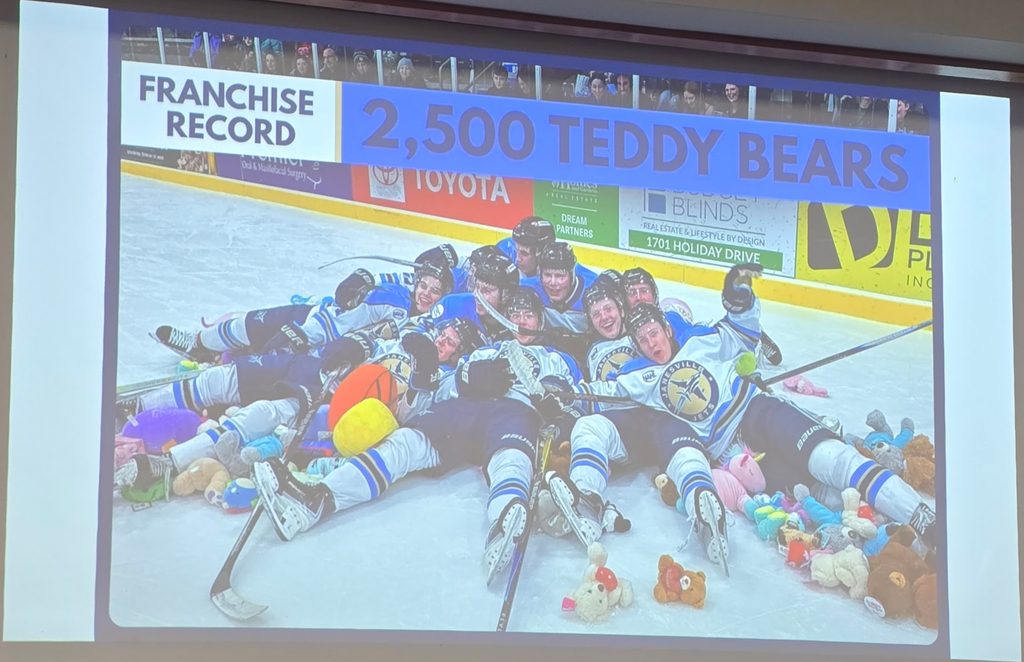
Teddy Bear Toss, which saw 2,500 bears last year, is a fun event where the bears are thrown onto the ice after the first home team score.
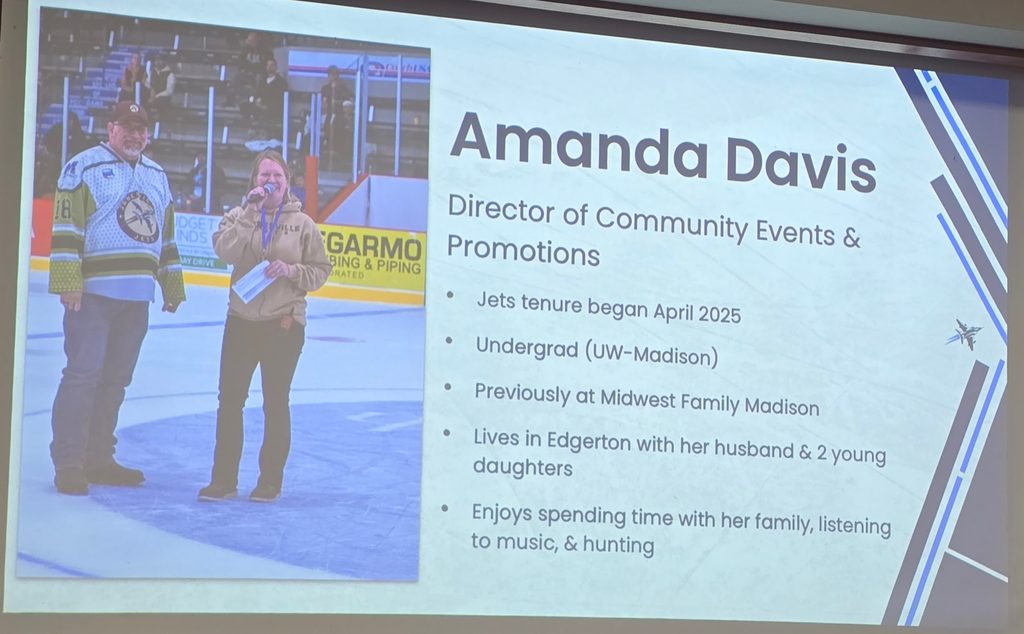
The Janesville Business Academy made the Janesville Jets logo. Andy mentored three of them last year.
Skate with the Jets is a regular event. Families can skate with the team after home games.
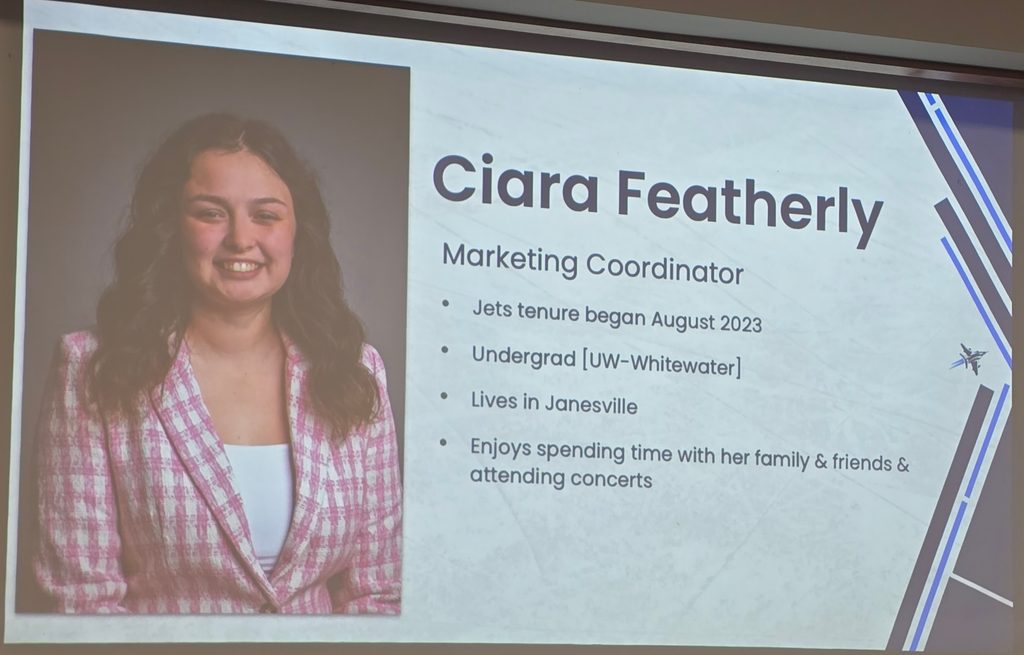
The Janesville Jets staff are community active. Staff members volunteered at Rotary and worked on the Japanese garden and one other, as one example.
Kiwanis member Tom Newman asked, “What became of the old ice arena?” Andy replied, “As best I know, they are tearing it down. Beloit College had an interest and backed out. It has had several break-ins, and a car drove into the entrance.”
Kiwanian John Janes had commentary about the two ice sheets, and walking in the arena. Andy mentioned the Mercy Health Arena second-level mezzanine is a popular place to exercise by walking around the 1/4-mile perimeter.
Kiwanis member Jim Farrell asked, “The Jets play away games. Do they fly to Alaska?” Andy answered, “Yes, they stay three weeks to play Alaska’s three teams. It is one of the few trips where they are not bussed.”
Jim Farrell stated, “I dislike the fighting. What policies are there?” Andy responded, “The referees in college and junior hockey have a hard rule against violence. In professional hockey, players routinely settle their differences.”
John Janes stated, “The young men out in the community are good examples.” Andy agreed, “Yes, several staff members keep them well behaved.”
John Janes inquired, “What sort of funding goes into keeping the players for the team, and to the billet family?” Andy responded, “I’m unsure. The families receive a maybe $400/month stipend.”
John Janes continued, “What is the season here?” Andy answered, “Mid-August to mid-April is when the team members are here. They’re back with their families around the country and world a few days for Christmas.”
Jim Farrell asked, “Do cruise nights cause problems?” Andy, “Not to my knowledge. We have a good relationship with the police.”
John Janes inquired, “Does parking become a problem?” Andy replied, “Generally not. Games are usually after the most busy business hours.”
Andy Zywicki’s presentation was well attended and appreciated.
Ryan Lewis thanked Andy Zywicki for speaking and presented him with a Kiwanis Parker pen.
Tom Neumann adjourned the meeting with a ring of the bell at 10:40AM.
Reminders: There is an executive board meeting next week.
Some members stuck around for the Kiwanis Foundation meeting.
On this day:
1520 Explorer Ferdinand Magellan and his fleet reach Cape Virgenes after transiting the Strait of Magellan between the Atlantic and Pacific Oceans, becoming the first Europeans to sail into the Pacific [1]
1774 First display of the word “Liberty” on a flag raised by colonists in Taunton, Massachusetts, in defiance of British rule in Colonial America
1797 The USS Constitution (Old Ironsides) is launched in Boston
1803 English scientist John Dalton reads his paper “On the Absorption of Gases by Water and Other Liquids” to the Manchester Literary and Philosophical Society, outlining his atomic theory
1833 Swedish chemist, engineer, and industrialist Alfred Nobel, who invented dynamite and other more powerful explosives and who also founded the Nobel Prizes, was born in Stockholm
1869 First shipment of fresh oysters arriving in San Francisco comes overland from Baltimore
1897 Yerkes Observatory of the University of Chicago is dedicated
1915 First transatlantic radiotelephone message, Arlington, Virginia, to Paris
1918 Margaret Owen sets a world typing speed record of 170 wpm for one minute
1940 American novelist Ernest Hemingway published his classic novel For Whom the Bell Tolls; it was later adapted into an acclaimed film
1942 Film musical “For Me and My Gal,” starring Judy Garland and Gene Kelly in his screen debut, and directed by Busby Berkeley, premieres in New York City
1949 Aldous Huxley, author of “Brave New World,” writes to congratulate George Orwell on his new novel “Nineteen Eighty-Four”
1959 Guggenheim Museum, designed by Frank Lloyd Wright, opens in New York City
1960 John F. Kennedy and Richard Nixon clash in the fourth and final presidential debate in New York City
1964 MLB Milwaukee Braves ask NL to allow them to move to Atlanta, Georgia
1964 The film version of “My Fair Lady,” directed by George Cukor and starring Rex Harrison and Audrey Hepburn, premieres in New York (Academy Award for Best Picture 1965)
1965 Nobel prize in chemistry is awarded to Robert B. Woodward
1967 Tens of thousands of anti-Vietnam War protesters march on the Pentagon, besieging the military headquarters for two days
1970 Nobel Peace Prize is awarded to Norman E. Borlaug
1971 Nobel prize in literature is awarded to Pablo Neruda
1975 Asylum Records releases “Nighthawks at the Diner,” the third studio album by singer-songwriter Tom Waits; the double LP was recorded with a live audience in a simulated nightclub setting
1975 Coast Guard Academy first allows women to enroll
1976 Nobel Prize in Literature is awarded to American Saul Bellow
1978 Rock musician Frank Zappa serves as both host and musical guest on NBC’s Saturday Night Live, appearing in several sketches and performing his songs “Dancin’ Fool,” “The Meek Shall Inherit Nothing,” and “Rollo”
1979 Ozzie Newsome begins an NFL streak of 150 consecutive games with receptions
1980 Phillies win their first World Championship in their 98-year history
1986 IBM reforms in South Africa
1987 Nobel Prize in Economics is awarded to American Robert Solow for his theory of economic growth
2001 “United We Stand” benefit concert for September 11, 2001, terrorist attack victims is held at RFK Stadium in Washington, D.C., organized and headlined by Michael Jackson and featuring Aerosmith, Mariah Carey, and The Backstreet Boys
—
Back to the Future Part II, released in 1989, starts out set in 1985 where the previous film in the series left off. Marty McFly, played by Michael J. Fox, along with Doc Brown, played by Christopher Lloyd, and Jennifer Parker, played by Elisabeth Shue, travel to the future in Doc’s DeLorean to save Marty and Jennifer’s future children. The date they travel to is October 21, 2015, the date which would become the first “Back to the Future” Day. In the years leading up to the day, photoshopped images appeared online that claimed the day of the DeLorean’s twenty-first-century time travel had arrived. But true fans of the film series knew they had to wait until 2015.
Many events were held during the inaugural celebration, some of which raised money for The Michael J. Fox Foundation for Parkinson’s Research. Screenings of the film or the whole series took place in almost 2,000 theaters on the date and on the following weekend. Similarly, Esquire Network showed the trilogy all day and on the following weekend. We’re Going Back was held at filming locations in California, the documentary Back in Time was released, and The Million McFly March was held. Michael J. Fox, Christopher Lloyd, and Lea Thompson appeared on Today, and Michael J. Fox and Christopher Lloyd appeared in character on Jimmy Kimmel Live. The day prior, Universal Pictures re-released the Back to the Future trilogy on DVD and Blu-ray. “Back to the Future” Day has continued to be marked by fans of the film in subsequent years.
When the first “Back to the Future” Day arrived, comparisons were made between what October 21, 2015, looked like, and what the film portrayed it as. There were no flying cars or hoverboards, but there were big-screen televisions and virtual reality goggles. Mr. Fusion was nowhere to be found, and Jaws 19 was not playing in theaters. The film had predicted that the Cubs would win the World Series in 2015, but they didn’t. However, they made it to the National League Championship Series that year, one step away from the World Series, and they won the World Series the following year, for the first time since 1908. October 21, 2015, was chosen as the date in the film because it was plausible that the World Series could take place on that date, and in the 1980s it didn’t appear that the Cubs would win a World Series anytime soon. In 1988, the year the film was written, the Cubs had gone 77–84. This made 2015 feel like a distant time, a time so far-off that perhaps their victory could be possible then.
—
Hagfish are an eel-like fish that have no bones, jaws, or scales, and most people would agree they are quite ugly. Not only is their appearance unsightly, but they ooze out slime at a quick rate—being able to fill up a two gallon bucket within minutes, and they also often eat dead animals—doing so by crawling through a carcasses mouth, anus, or gills, and eating it from the inside out. Hagfish Day was created in 2009 by WhaleTimes to encourage children to examine all creatures in the food web, not just sightly looking ones. The day exists to show us that all animals in an ecosystem contribute to its well being, such as hagfish and many other often looked over creatures. We need to be made aware of hagfish and other lesser known creatures, because they are just as vulnerable as cute and elegant ones. In short, today is a day to “celebrate the beauty of ugly”.
—
Today is for babbling and for celebrating babblers. While a babbler is a term that can be ascribed to someone who seems to talk nonstop about nothing, it can also apply to a baby making noise who is in the process of learning how to talk. Another name for a babbler is a blatherskite. We could try to describe this holiday in more depth, but then we would just be babbling, because there really isn’t much more to say. But to go on would be fitting, though, wouldn’t it? We just love babbling about holidays anyway. Holidays are great, some of our favorite holidays…
—
Nachos trace their roots to the border of Mexico and Texas. One day in 1943, the wives of ten U.S. soldiers stationed at Fort Duncan in Eagle Pass, Texas, crossed the border into Piedras Negras, Mexico. When they stopped to eat at Club Victoria, chef Ignacio “Nacho” Anaya threw together a snack to give them—made with broken up tortillas, melted cheese, and jalapeño peppers—and called it “Nachos Especiales.” In 1954, his recipe was published in St. Anne’s Cookbook, by the Church of the Redeemer in Eagle Pass, suggests the women had brought the recipe back over the border.
International Day of the Nacho started in 1995, when the government tourism office in the Mexican state of Coahuila—where Piedras Negras is located—made a formal decree for the day, and acknowledged Anaya as the creator of the nacho. A bronze plaque was installed in his honor, and his son was on hand to judge a nachos cook-off. The competition became an annual event, and part of Nachos Fest, which is held in Piedras Negras in October each year.
There are many variations of nachos. “Ballpark nachos”—covered with jalapeños and melted cheese, not far removed from Igancio’s original recipe—were invented by Sal and Margarita Manriquez, and are now popular at sports stadiums. Sal Manriquez started selling them as “Margarita’s State Fair Nachos” at the State Fair in Dallas in 1964, and in 1975 asked to sell them at Arlington Stadium, where the Texas Rangers then played. Manriquez was turned down and later found out that the stadium was selling a version of his nachos anyway.
Nachos with a lot of toppings are often called “loaded nachos” or “super nachos.” They are usually served as an appetizer at bars or restaurants but are often seen as a meal in and of themself. Chips are placed on a platter, and meat, refried beans, and shredded cheese are put on top. The cheese is melted, and then cold toppings such as lettuce, tomatoes, and salsa are added on top. Barbecue nachos are popular in Memphis, Tennessee, which include barbecued pork shoulder and barbecue sauce. Kalua pork and pineapple nachos are popular in Hawaii. There are countless other variations of nachos that can be made.
—
Apple Day is mainly celebrated in the United Kingdom, where it was started. Common Ground, a group dedicated to building strong communities, strengthening local distinctiveness, and connecting people with nature and each other, held the first Apple Day in 1990, at Covent Garden in London, England. Their goal was to create an autumn holiday that would not only be celebrated in London, but also in other cities, villages, parishes, markets, and even orchards. They wanted to demonstrate the richness and diversity of apples, but also the diversity of landscape, ecology, and culture as a whole.
Many different activities have taken place on the day. First and foremost has been the buying, tasting, and eating of apples. Other activities have included juicing, pruning, grafting, and identifying apples, and games, songs, and poetry about apples. In England, many groups such as museums, shops, restaurants, horticultural societies, Wildlife Trusts, National Trust properties, and schools organize activities for the day. By the second year of Apple Day, there were over 60 events. There were over 300 events in 1997, and 600 by the new millennium. Not all “apple days” are held on October 21. Some groups hold these celebrations on other days of the month.
Through the day’s success, it has not only demonstrated the importance of the apple but the importance of local celebrations as well. The day has germinated local pride and grown interest in local distinctiveness. Apple Day has also led to an interest in raising awareness for the origins of food and to encouraging healthy eating.
The apple tree is a deciduous tree from the rose family and is cultivated around the world as a fruit tree. It originated in Central Asia; its ancestor is the malus sieversii, which still grows today. Apple trees grew for thousands of years in Asia, as well as in Europe—the starting place of Apple Day—before being brought to North America by European colonists in the seventeenth century. They are possibly the oldest tree to have been cultivated. The only apples native to North America are crab apples. Reverend William Braxton of Boston planted the first apple orchard on the North American continent in 1625. Apples were cultivated on colonial farms and spread along Native American trade routes. Johnny Appleseed introduced apple trees to the western frontier. Today apple trees are prominent in Eastern Washington, where apples are their leading product, and more apples are grown there than any other state.
If grown by seed in the wild, an apple tree can tower up to 30 feet, but they are generally 6-15 feet in height when cultivated. The height of the cultivars depends on how they were grafted onto rootstocks. There are over 7,500 cultivars of apples, which are grown for various purposes such as eating raw, cooking, and cider making. Apple tree flowers blossom in the spring, and the leaves bud at this time as well. Flowers cluster in groups of four to six and the center flower is called the “king bloom.” It opens first and can grow into larger fruit than the other flowers. The fruit is ready to pick by late summer or fall.
Minutes by Ryan Lewis.
Credit: Ryan Lewis, photographs.
Note: Kiwanis and its members are not responsible for errors or omissions. We are open to discussion if you would like to request an alteration. This content may only be reproduced without alteration and with credit to the original author(s).


Leave a Reply
You must be logged in to post a comment.