

Blackhawk Golden ‘K’ General Meeting
Minutes
August 26th, 2026
Richard Johnson presided, and called the meeting to order with a ring of the bell at 9:30AM.
An Executive Board meeting occurred today.
Richard Johnson led with the singing of America, the National Anthem, and the Pledge of Allegiance.
Invocation: Richard Johnson, mentioning the children.
Raffle: Steve Skelly oversaw the ticket sales and drawing this week.
The weekly pot was $13 and the big (Joker) pot was $282.
Hamish Martin drew a ticket from the bucket, ticket number 5986. Congratulations to the winner, Don Kellogg.
The deck of cards has 32/53 cards remaining. Don Kellogg drew the 3♠.
Happy Box: Don Kellogg and Dick Fag announced they are happy because they won the raffle. They are donating the proceeds to the Salvation Army.
Richard Johnson announced that Jean and Hamish Martin are guests today!
Jokes: Joker Steve Skelly had a good joke about a man with health problems during a traffic stop.
Member Health: Mel Lemirande had a status update on John Sarnow, who is having problems hearing and digestive issues.
Linda Bontly had a status update on Paul Neitzel’s wife, who was in a traffic accident, and has an arm broken in three places.
Other Announcements: Mel Lemirande spoke upon having cacti available for giveaway, of which Ryan Lewis was quick to request the first.
John Janes spoke upon the Pistons and Props airshow seeking volunteers, which occurs this weekend!
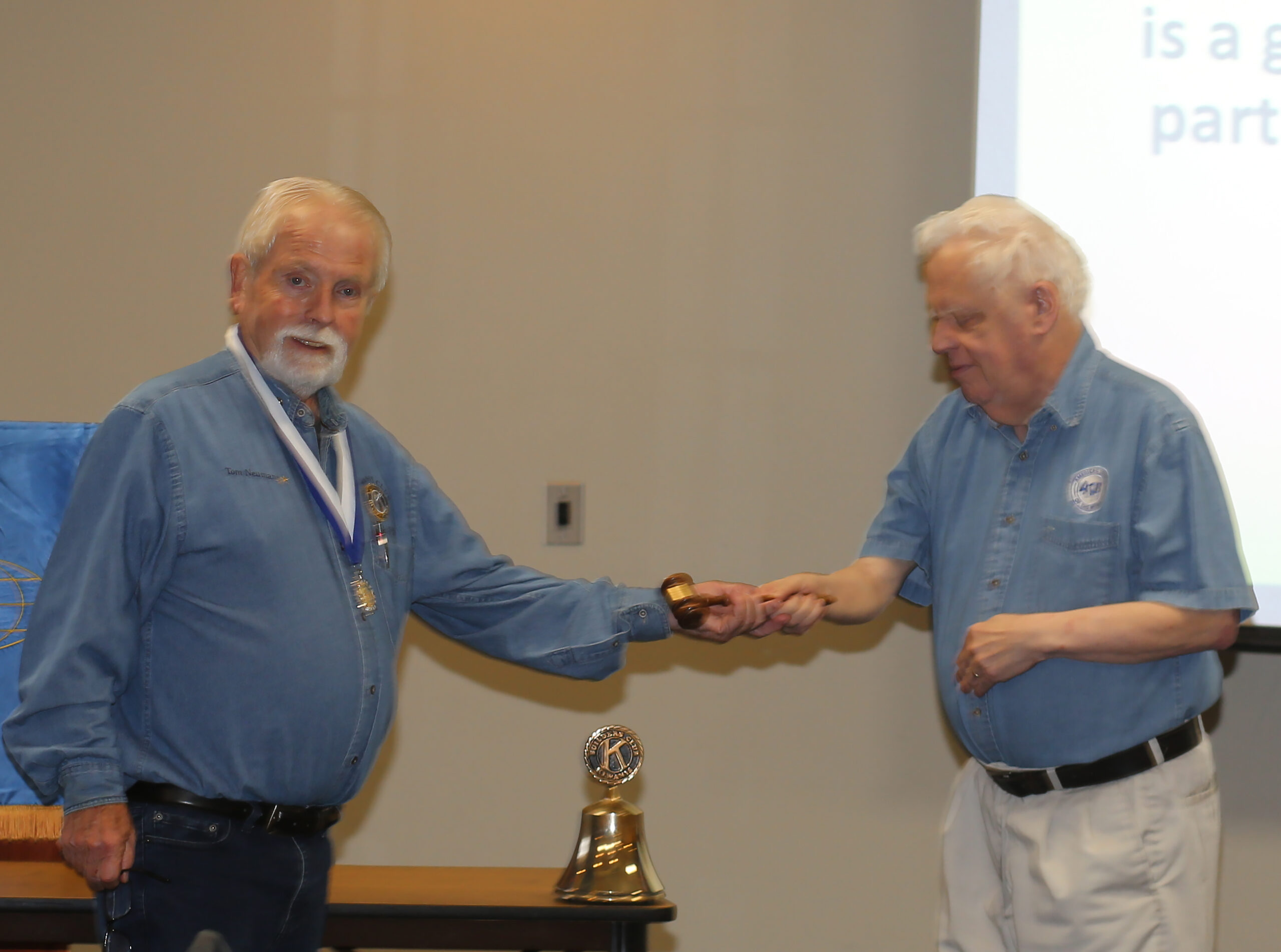
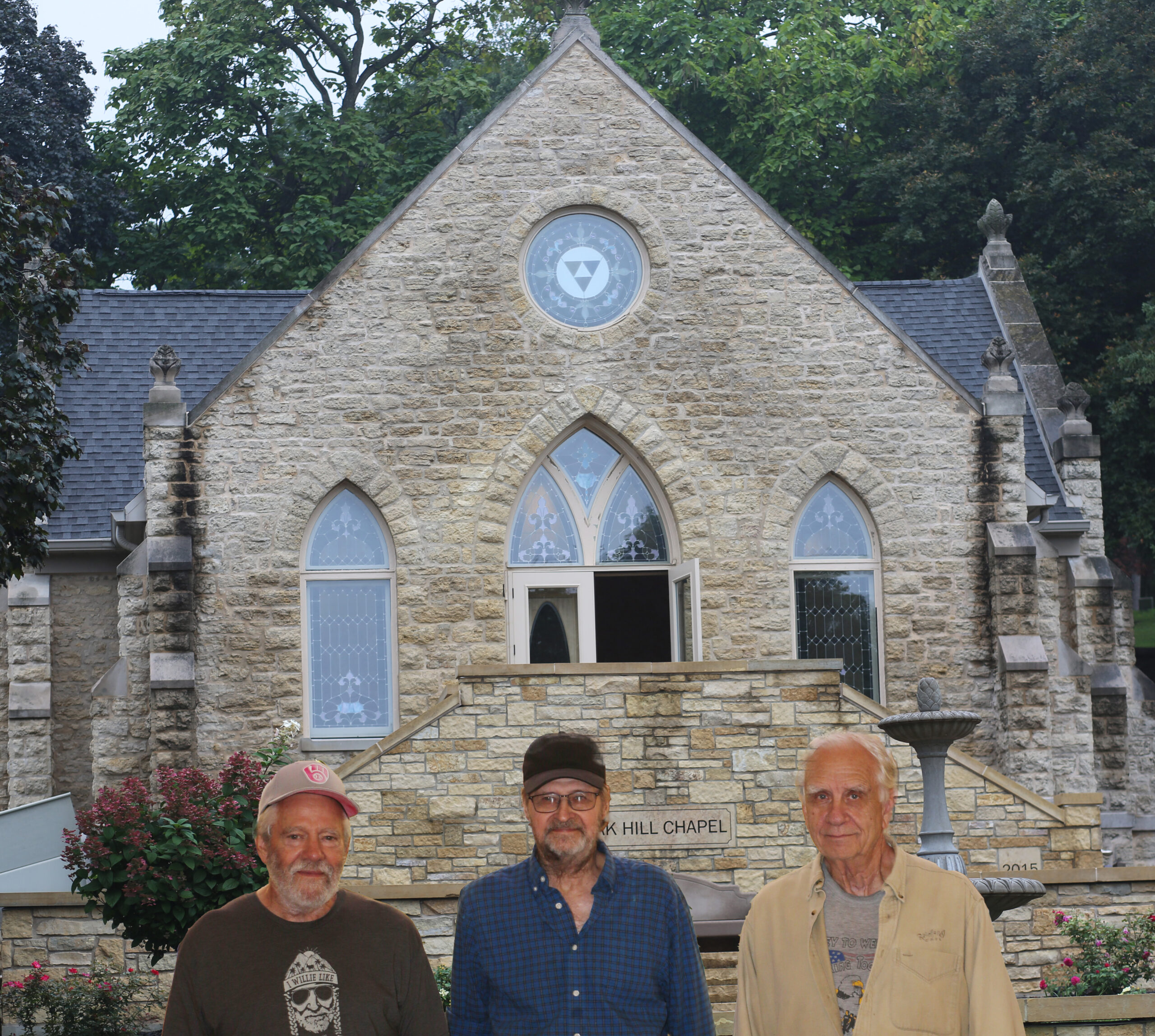
Tom Neumann spoke upon the September 9th meeting, occurring at a different venue, Oakhill Cemetery Chapel. The Senior Fair is the 11th, and the Farmer’s Market is on the 12th.
John Janes spoke upon the Tree Sale. Selections for trees to sell are needed.
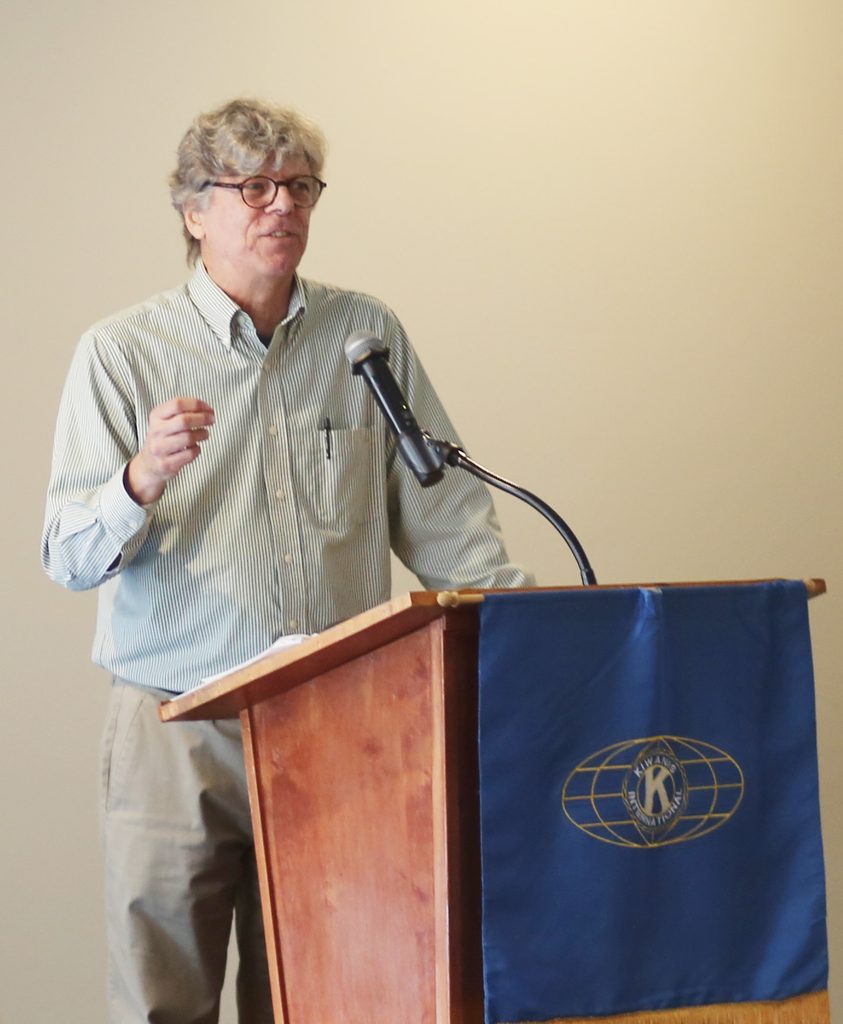
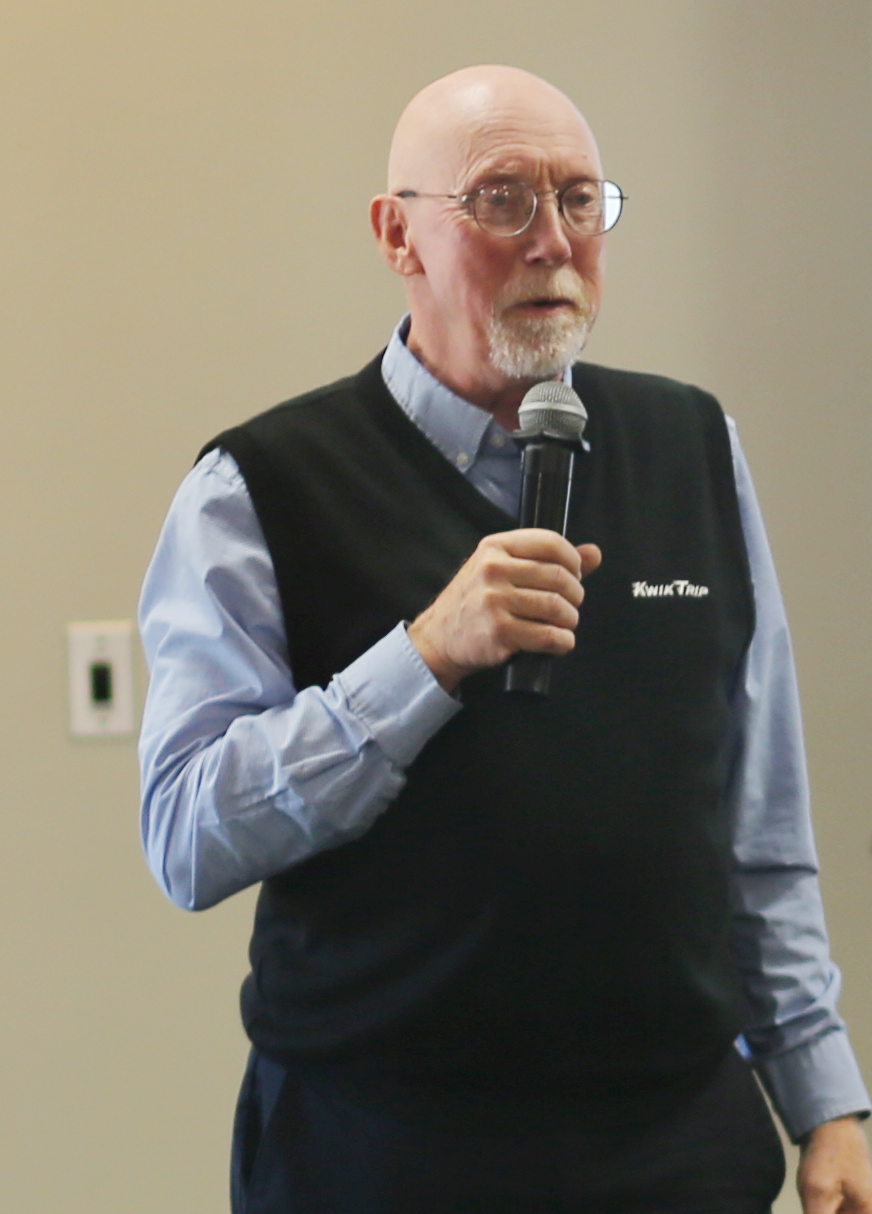
April Wright introduced the day’s speaker, John Graf. John is a member of the Society for American Baseball Research (Saber, for short). He has been a member of the organization’s Negro Leagues Research Committee and a Janesville newspaper sportswriter and radio news reported and announcer. Jerry assisted for several years in the planning of SABR’s annual Jerry Malloy Negro League Conference, including collaborative editorship of the event’s souvenir booklet. John’s current book, Simulating Satchel: A What-If History of Integrated Major League Baseball in 1934, this summer received SABR’s Robert Peterson Recognition Award, given to the organization’s top authors of the year. In addition, John edited (with associate editors Larry Lester and Duke Goldman) From Rube to Robinson: SABR’s Best Articles on Black Baseball. He is a retired employee of the Wisconsin legislature, where he served as a nonpartisan assistant clerk for the state Assembly. John resides in Beloit.

John began with stories of his childhood baseball love. John’s father was artistic. He painted something that is in the white house. John has a baseball card his father drew of John while John was a young boy.
John began, “Satchel Paige was a great pitcher.”

Satchel started in the negro leagues in his twenties. He had many of his own pitches.
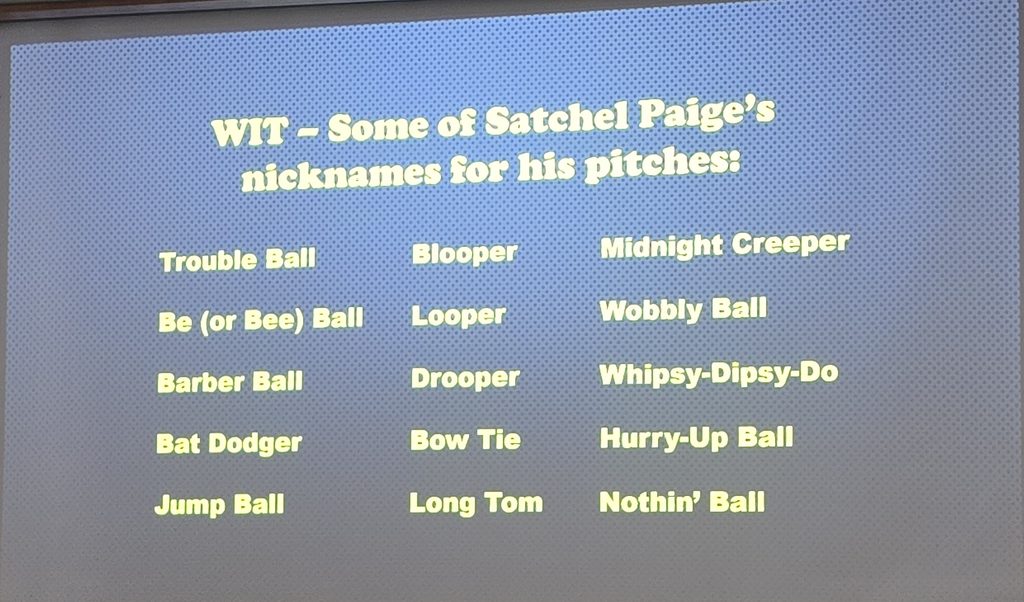
He joined the Major League in his forties. A video of Satchel warming up was played.
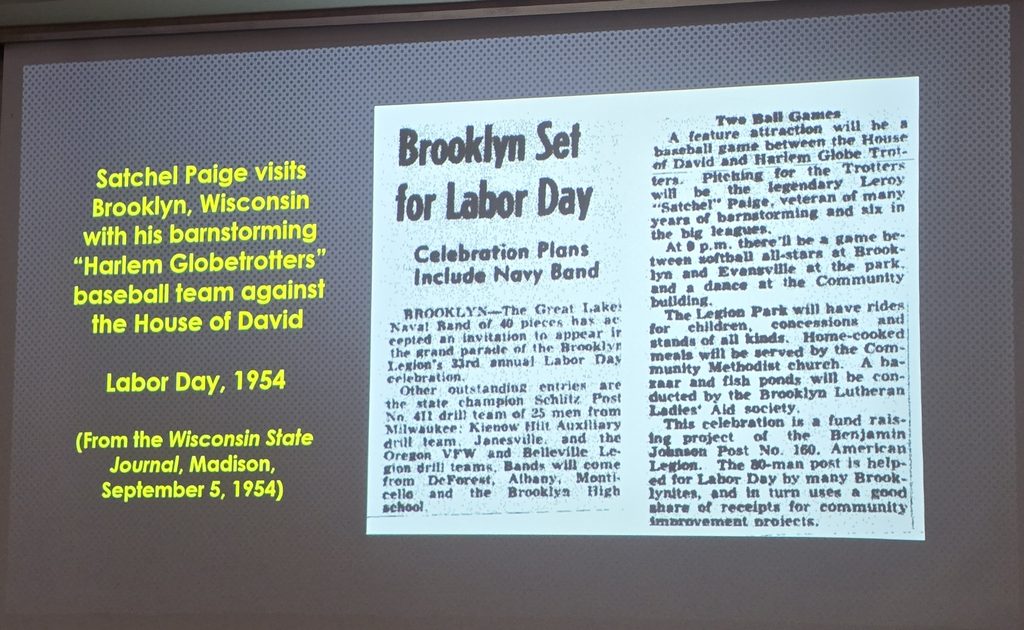
The Beloit News interviewed Satchel when he was around 52 years old. At 59 years old, he played and struck out others.

Kiwanis member Ray Szczepaniak asked, “When were players integrated?” John replied, “1947.”
Kiwanian Greg Dickinson inquired, “Were Hispanics playing?” John responded, “Yes. Perucho Cepeda is a good example of a player in Latin America.”
John Graf mentioned he will present with Rodney Page in Kansas City next week, at the B6 Symposium.

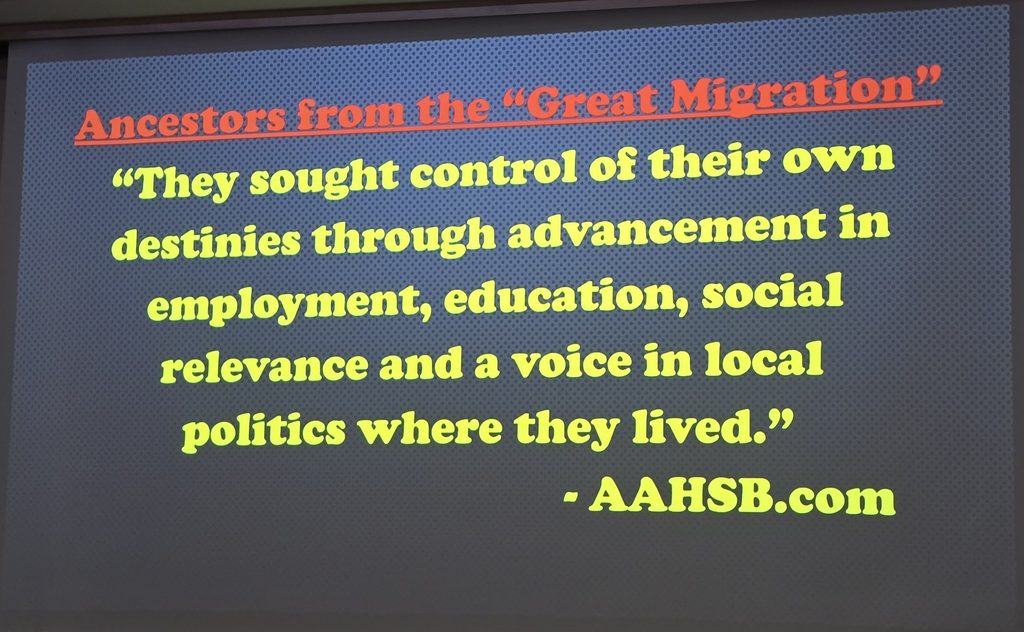
A group, the African American Historical Society of Beloit, states that 100 black players were in the leagues.
Kiwanis member Jerry Langdok asked, “What value would a Satchel Paige baseball card have?” John responded, “I am unsure. Hundreds? More?”
Satchel Paige played in Beloit as late as the 1960s.
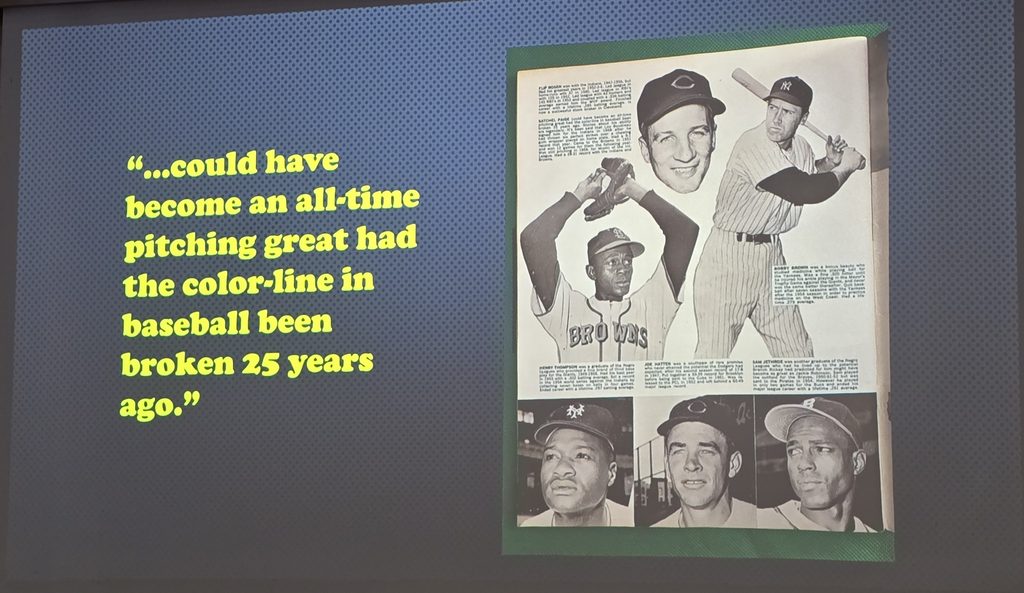
Kiwanian Tom Neumann inquired, “What did black players earn on average?” John, “Satchel had some business sense. He drew crowds, and brought along his teammates.”

Kiwanis member John Janes asked, “Was there a catcher able to field all of the wild throws Satchel had?” John replied, “He had several. They traded signals similar to modern games.”
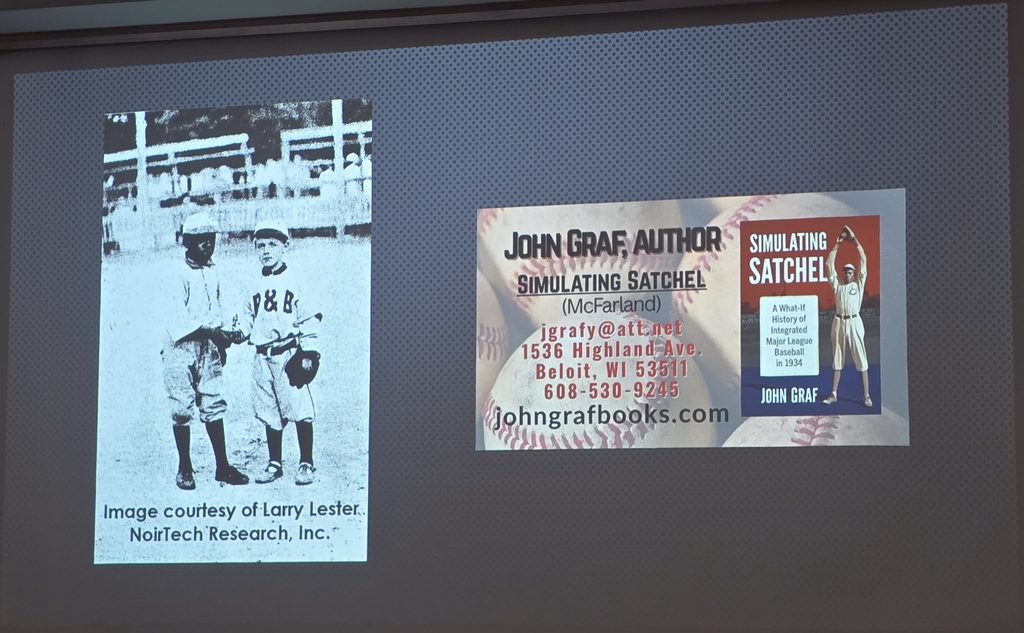
John’s presentation was well received and appreciated.

April Wright thanked John Graf for speaking and presented him with a Kiwanis Parker pen.
Richard Johnson adjourned the meeting with a ring of the bell at 9:40AM.
Reminders: Please purchase the speaker’s book.
On this day:
1498 Michelangelo is commissioned to carve the Pietà sculpture by French Cardinal Jean de Bilhères
1682 English astronomer Edmond Halley first observes the comet named after him
1691 Charles Perrault’s poem “The Marquise of Salusses or the Patience of Griselidis” is read aloud at the French Academy and later attached to his “Tales of Mother Goose” (1697)
1748 First Lutheran denomination in North America, the Pennsylvania Ministerium, is founded in Philadelphia, Pennsylvania
1791 John Fitch granted US patent for his working steamboat
1843 American inventor Charles Thurber patents a typewriter
1856 An 18-year-old chemist William Henry Perkin patented the world’s first synthetic dye. He had discovered the brilliant purple substance accidentally while trying to make quinine, a malaria treatment. Dubbed mauveine, the dye made fashionable purple clothing far more affordable, sparked a “mauve mania,” and helped launch the modern synthetic dye and chemical industries.
1873 The first free kindergarten in the United States is started by Susan Blow in Carondelet, a suburb of St. Louis, Missouri
1883 The volcano Krakatoa in Indonesia began to erupt, and caused a tsunami
1895 Electric generator at Niagara Falls produces its first power
1903 Phillies walk 17 Dodgers in a game
1907 Harry Houdini escapes from chains underwater in 57 seconds at Aquatic Park in San Francisco, California
1916 Philadelphia Athletics’ Bullet Joe Bush no-hits Cleveland 5-0
1920 The Nineteenth Amendment became part of the Constitution of the United States, giving women the right to vote
1951 Dutch professor Jacob Jongbloed demonstrates an artificial heart in Paris
1951 The film “An American in Paris,” with music by George Gershwin, directed by Vincente Minnelli, and starring Gene Kelly and Leslie Caron, premieres in London (Academy Award for Best Picture, 1952)
1967 The Beatles, Mick Jagger, Marianne Faithfull, and Donovan meet Maharishi Mahesh Yogi at a retreat in Bangor, Wales
1968 “Hey Jude” single is released by the Beatles in the US (Billboard Song of the Year 1968, Billboard 10th biggest song of all time 2013)
1971 The New York Giants football team announces they are leaving the Bronx for New Jersey in 1975
1972 XX Summer Olympic Games open in Munich, West Germany
1973 The University of Texas at Arlington is the first accredited school to offer belly dancing
1978 Soyuz 31 carries two cosmonauts, including one East German, to space station Salyut 6
1981 Space Shuttle vehicle moves to Launch Complex 39A for the STS-2 mission
1981 Voyager 2 takes photos of Saturn’s moon Titan
1982 NASA launches the Telesat-F satellite
1988 Iranian refugee Mehran Karimi Nasseri arrives at Charles de Gaulle International Airport in Roissy-en-France, France, and stays for almost 18 years, inspiring director Steven Spielberg to make the film “The Terminal” about his life
1996 US President Bill Clinton signs welfare reform into law, representing a major shift in welfare policy
1999 Michael Johnson breaks the 400 m world record with a time of 43.18 seconds
National Dog Day was founded in 2004 by Colleen Paige. She is a pet and family lifestyle expert and animal advocate, who has also founded days such as National Mutt Day, National Puppy Day, and National Cat Day. The day happens to take place on the anniversary of the day when her family adopted their first dog when she was ten. National Dog Day is for all dogs, both purebred and mixed, and the mission of the day is to raise awareness about the number of dogs that need to be rescued each year, as well as to acknowledge the role dogs have played to keep us safe and bring us comfort. Dogs work with law enforcement, are eyes for the blind, and help the disabled, and they enrich our lives in a myriad of ways.
When asked what they would most want on a deserted island, almost half of all people choose toilet paper. Maybe that gives us a clue as to why there is a National Toilet Paper Day. It is one of those things we sometimes take for granted, until we can’t find any. It wasn’t always around though. Rich people used to wipe or clean themselves with wool, lace, or hemp, but common folk used things such as leaves, grass, seashells, corncobs, sponges on a stick, water, stones, hay, and yes, the smooth edges of broken pottery jugs. The first mention of paper being used for cleaning oneself is in China in the 6th century A.D. It was also in China, in the 14th century, that a form of toilet paper began being produced on a large scale. Commercial toilet paper as we think of it today was invented by Joseph Gayetty, and hit the market in 1857. This toilet paper was sold in flat sheet packages, and was available until the 1920’s. Meanwhile, Seth Wheeler patented rolled toilet paper in 1883, and an improved version of it in 1891. Nowadays, close to 30,000 trees are used every day to make toilet paper, with an average tree producing 100 pounds. Americans love their toilet paper, using almost double the amount of other Western countries per person. This partly can be attributed to the use of bidets in some Western countries. Americans now like their toilet paper plain though. Starting in the 1960’s, toilet paper was sometimes colored to match the hue of bathrooms. Pink and green rolls were very common. By the early 2000’s colored toilet paper stopped being made in the United States, but it is still made in other parts of the world.
Women’s Equality Day commemorates the adoption of the Nineteenth Amendment, which prohibits denying the right to vote to citizens of the United States on the basis of sex. Prior to its adoption, women were not guaranteed the right to vote on the national level. The first time an amendment dedicated to women’s suffrage was introduced was in 1878, and similar amendments were introduced numerous times over the next 41 years until the House and Senate both approved the amendment in 1919. Then it needed to be approved by two-thirds of the states, and it was lobbied for by suffragists. On August 24, 1920, Tennessee became the 36th state—and final state needed—to ratify it. On August 26, 1920, Secretary of State Bainbridge Colby signed a proclamation that added the Nineteenth Amendment to the Constitution.
Fifty years to the day later, The National Organization for Women, led by Betty Friedan, held the Women’s Strike for Equality. The day was known by some as Women’s Equality Day. It was the largest protest for gender equality in United States history up until that time. Protests and rallies were held in more than 90 cities, with 100,000 women participating. In New York City alone, 50,000 women marched down Fifth Avenue.
In 1971, Congresswoman Bella Abzug [D-NY] introduced a resolution to designate August 26th as Women’s Equality Day. It did not pass. The following year, President Richard Nixon issued Proclamation 4147, designating August 26, 1972, as Women’s Rights Day.
Minutes by Ryan Lewis.
Credit: Dave Figi, and Ryan Lewis, photographs.
Note: Kiwanis and its members are not responsible for errors or omissions. We are open to discussion if you would like to request an alteration. This content may only be reproduced without alteration and with credit to the original author(s).



Leave a Reply
You must be logged in to post a comment.