Blackhawk Golden ‘K’ General Meeting
Minutes
April 8th, 2026
President Elect Tom Neumann presided, and called the meeting to order with a ring of the bell at 9:30AM.
29 members were in attendance today.
Tom Neumann led with the singing of America, the National Anthem, and the Pledge of Allegiance.
Invocation: Dave Calverley, mentioning goodwill and the children.
Raffle: John Janes oversaw the ticket sales and drawing this week.
The weekly pot was $11 and the big (Joker) pot was $52.
Linda Bontly drew a ticket from the bucket, ticket number 770. Congratulations to the winner, Mel Lemirande.
The deck of cards has 49/53 cards remaining. Mel Lemirande drew the J♠.
Tom Neumann thanks greeters Ryan Lewis and Bob Wilcox, invocator Dave Calverley, rafflemaster John Janes, and server Glenn Disrude.
Happy Box: Tom Neumann announced he is happy because of the reprieve from war.
Roger Willeford announced he is happy because the Willefords are visiting their daughter and family in Montana this weekend.
Jim Farrell announced he is happy because the election went well, with capable people and a good turnout.
Jokes: Joker Glenn Disrude had a good joke: It took 16 years to build Big Ben. It could have taken longer, but they were working around the clock.
Bob Knudson had some good adages about growing old.
Other Announcements: Tom Neumann spoke upon the meeting upon May 20th, which is at Oak Park instead of Rotary.
Linda Bontly spoke upon Lily Day, a success, which took in a total of $1,891.52!
Bob Knudson reminded everyone to collect for the Ronald McDonald House Charity, and the can will be out every week.
Tom Neumann announced, golfing starts next week!
Committee Reports: Ray Szczepaniak announced we received a ‘Thank you’ letter from the Key Club.
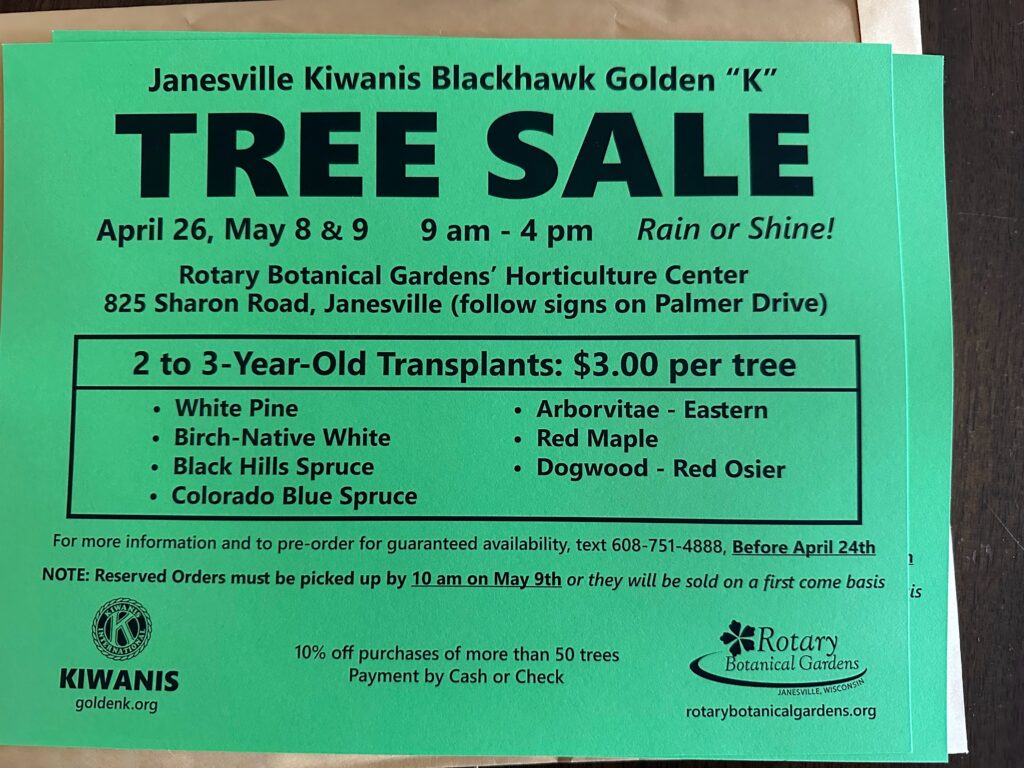
John Janes announced the Tree Sale is kicking off on April 26th. Fliers are printed!
John Janes introduced the day’s speaker, Rachel Badura. Rachel is the blood drives coordinator at the Red Cross. She worked with them for 16 years, and then four years ago was promoted. The Red Cross hosts blood drives all over the country. Kiwanis’ events alone collected 2,267 units last year, and three lives can be saved per unit. Rachel educated the membership about blood drives.
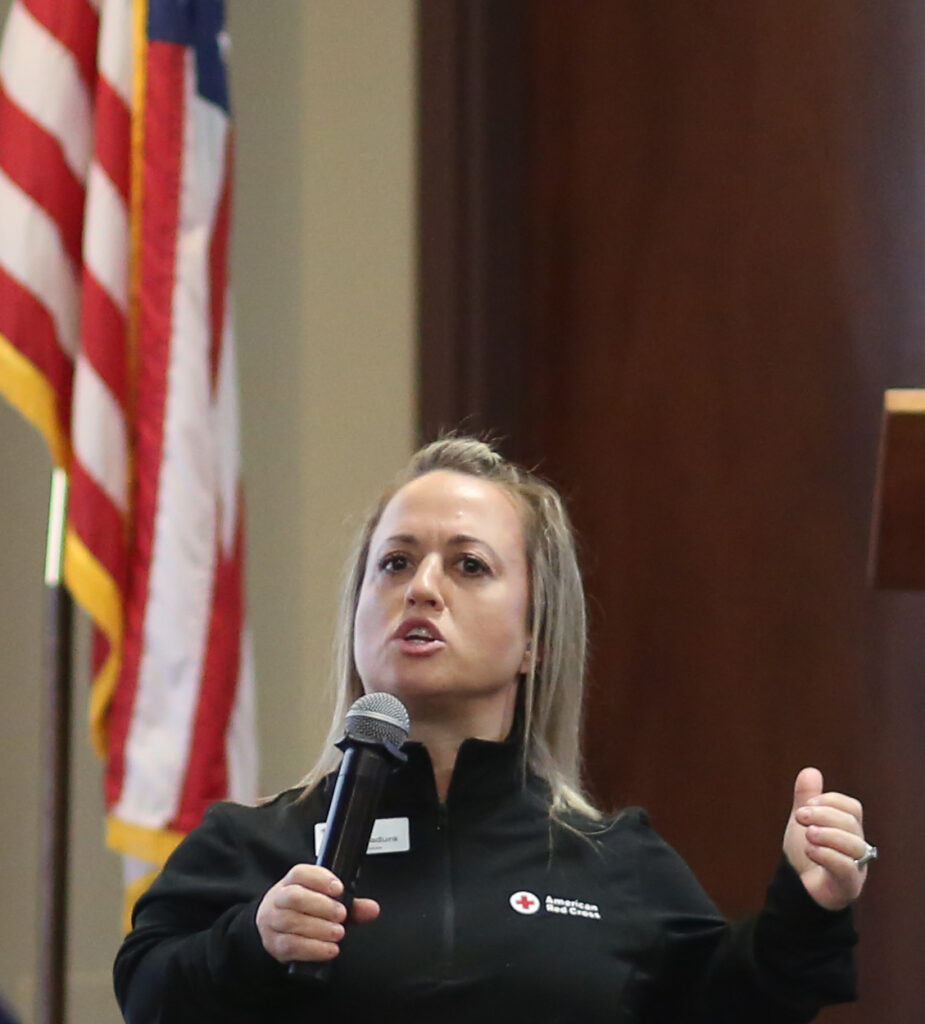
Blood drives are everywhere, and for good reason. During the snowstorm two weeks ago, 15-16,000 units were lost then alone. Blood has a shelf life of 42 days in optimal conditions. Donations can only be made every 56 days.
Power reds, two units of O-, O+, A- or B-, where the blood cells are donated and plasma, platelets and saline are returned, can be given every 112 days.
The Red Cross is already planning blood drives into January of 2027. They are the only blood bank licensed to send blood overseas to the military.
If you haven’t checked lately, ask again! Many medications and health conditions are now acceptable donations.
You only have to be 16 years old (with parental consent) to donate.
Kiwanis member Steve Skelly asked, “Platelets have a 5-7 day shelf life, and the only nearby equipment to donate them is in Madison. Does the Red Cross have group transportation or some other support? Rachel answered, “Good question, I will look into that.”
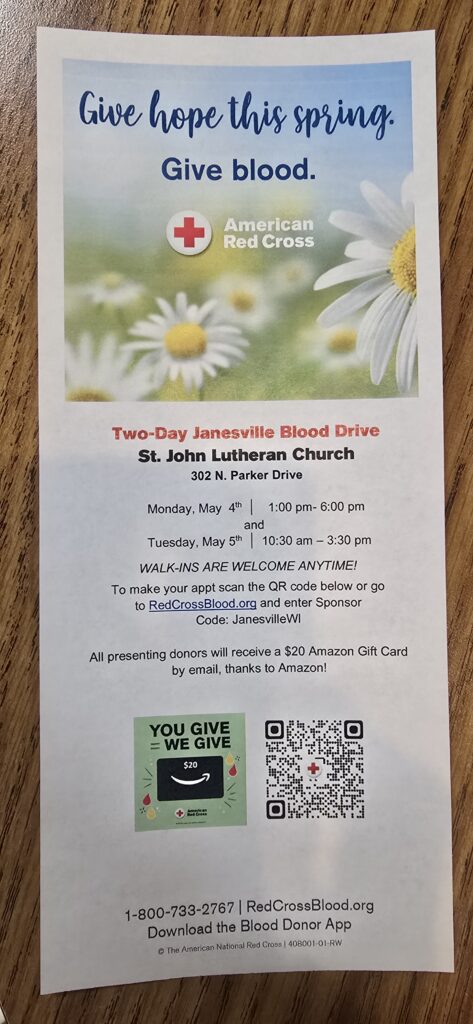
Kiwanian Bob Knudson inquired, “How do you sing up?” Rachel responded, “Use RapidPass from the fliers’ QR code, the donor app, or just show up! If you use RapidPass the day off, you can express your sign in.”
Kiwanis member Bob Wilcox asked, “What about bans as a result of world travel?” Rachel answered, “Many of those bans were lifted a few years ago. Give it a try.”
Jim Farrell inquired, “Is blood pressure over the shirt accurate?” Rachel responded, “Generally, yes. Over a sweater is not advised.”
Kiwanian Mel Lemirande asked, “How does blood pressure affect the blood?” Rachel replied, “If your blood pressure is high, your heart is working harder, which causes concern about the donor.”
Kiwanis member Tom Neumann inquired, “Is the blood STD tested?” Rachel, “Yes, immediately, at a lab.”
Mel Lemirande asked, “Alcohol consumption is a problem?” Rachel answered, “Alcohol consumed in close proximity to donation has thinned the blood, which affects the donor. It has no effect on the recipient.”
Bob Wilcox inquired, “Is supply sufficient?” Rachel, “It is always needed. A 15-16,000 units supply was lost during the recent snowstorm. Summer can be equally difficult, because students are not in school to donate.
Tom Neumann asked, “What about business’ donations, such as Seneca Foods?” Rachel responded, “Yes, businesses are evaluated, and then 6-7 beds are available, or less if a smaller location.
John Janes added, “and they are streamlined. Pre-pandemic to post, it is now reservations. Red Cross brings the truck and are set up in less than an hour. You can be done giving in 30 minutes.”
John then inquired, “What are better blood types for children?” Rachel replied, “O- is a universal donor. Anyone whose blood lacks the RH protein (negative blood types) are more sought after.”
Jim Farrell added, “A big improvement is they now notify you when you are ready again.”
Steve Skelly asked, “They are doing A1C testing?” Rachel responded, “Red Cross have a different promo every month. Currently, we have $20 Amazon gift cards coming up in May.”
Rachel’s presentation was well attended and appreciated.
John Janes thanked Rachel Badura for speaking and presented her with a Kiwanis Parker pen.
Tom Neumann adjourned the meeting with a ring of the bell at 10:55AM.
On this day:
1766 First fire escape is patented: a wicker basket on a pulley and chain
1781 Premiere of Mozart’s “Violin Sonata No. 27” in G major (K. 379)
1783 Catherine II of Russia annexes the Crimea
1796 Carl Friedrich Gauss, German mathematician, proves the quadratic reciprocity law (the ability to determine the solvability of any quadratic equation in modular arithmetic)
1820 The famous ancient Greek statue Venus de Milo is discovered on the Aegean island of Milos
1838 Steamship “Great Western” makes her maiden voyage from Bristol, England, to New York
1879 Milk is sold in glass bottles for the first time
1904 New York City changes the name of Longacre Square to Times Square, in honor of The New York Times’s move to the area
1910 1st race at the Playa Del Ray Motordrome, 1st US auto speedway, is held near Los Angeles, California
1913 17th Amendment to the United States Constitution is ratified by Congress, providing for election of senators by popular vote
1914 US and Colombia sign a treaty concerning Panama Canal Zone
1947 Largest recorded sunspot ever observed at 40 times the diameter of Earth
1960 US Senate passes Civil Rights Bill with measures against discriminatory voting practices
1963 35th Academy Awards: “Lawrence of Arabia”, Anne Bancroft & Gregory Peck win
1964 Unmanned Gemini 1 launched
1966 American Football League votes in 36-year-old Al Davis as commissioner after Joe Foss resigns; appointment lasts 3 months when AFL merges with NFL
1966 OAO 1, the first orbiting astronomical observatory, launches
1973 Pablo Picasso, one of the most influential artists of the 20th century, died in France at age 91.
1974 Discovery Island opens at Walt Disney World, Florida
1974 Hammerin’ Hank Aaron hits his 715th home run off LA Dodger Al Downing in Atlanta, breaking Babe Ruth’s record
1974 Paul McCartney and Wings release single “Band on the Run” in the US
1975 47th Academy Awards: “The Godfather Part II”, Ellen Burstyn & Art Carney win
1979 205th & final episode of “All in the Family”; followed by “Archie Bunker’s Place” for 4 seasons
1979 People’s Republic of China joins International Olympic Committee
1982 Tracy Caulkins wins her 36th US swimming title aged 19
1983 In front of a live audience of 20 tourists, David Copperfield makes the Statue of Liberty disappear
1984 U.S. Census Bureau estimates rank Los Angeles as second most populated city, displacing Chicago which held the position since 1890; New York City remains the top
1985 Amdahl releases UTS/V, the first mainframe Unix
1986 Clint Eastwood elected mayor of Carmel, California, makes his day
1990 “Twin Peaks” created by David Lynch and starring Kyle MacLachlan premieres on ABC-TV
1991 Oakland A’s stadium becomes 1st outdoor arena in USA to ban smoking
1993 STS-56 (Discovery) launches into orbit
1994 Smoking is banned in the Pentagon and all US military bases
1997 Microsoft releases Internet Explorer 4 Beta
1997 STS 83 (Columbia 22) lands
Most practitioners of Buddhism in Japan celebrate the birth of the Buddha, who lived in India sometime between the 6th and the 4th century bce and was the founder of Buddhism.
It’s Zoo Lovers Day! A Zoo—short for a zoological park—is a place that contains animals and exists to entertain, educate, engage in scientific research, and focus on conservation. Early zoos, known as menageries, were private collections of animals held by the wealthy. They existed as early as 2,500 BCE, being found in Egypt and Mesopotamia. They were found soon afterward in ancient China, Greece, and Rome. Aztec Emperor Montezuma II had one of the first collections of animals in the Western Hemisphere.
Minutes by Ryan Lewis.
Credit: Dave Figi, and Ryan Lewis, photographs.
Note: Kiwanis and its members are not responsible for errors or omissions. We are open to discussion if you would like to request an alteration. This content may only be reproduced without alteration and with credit to the original author(s).